

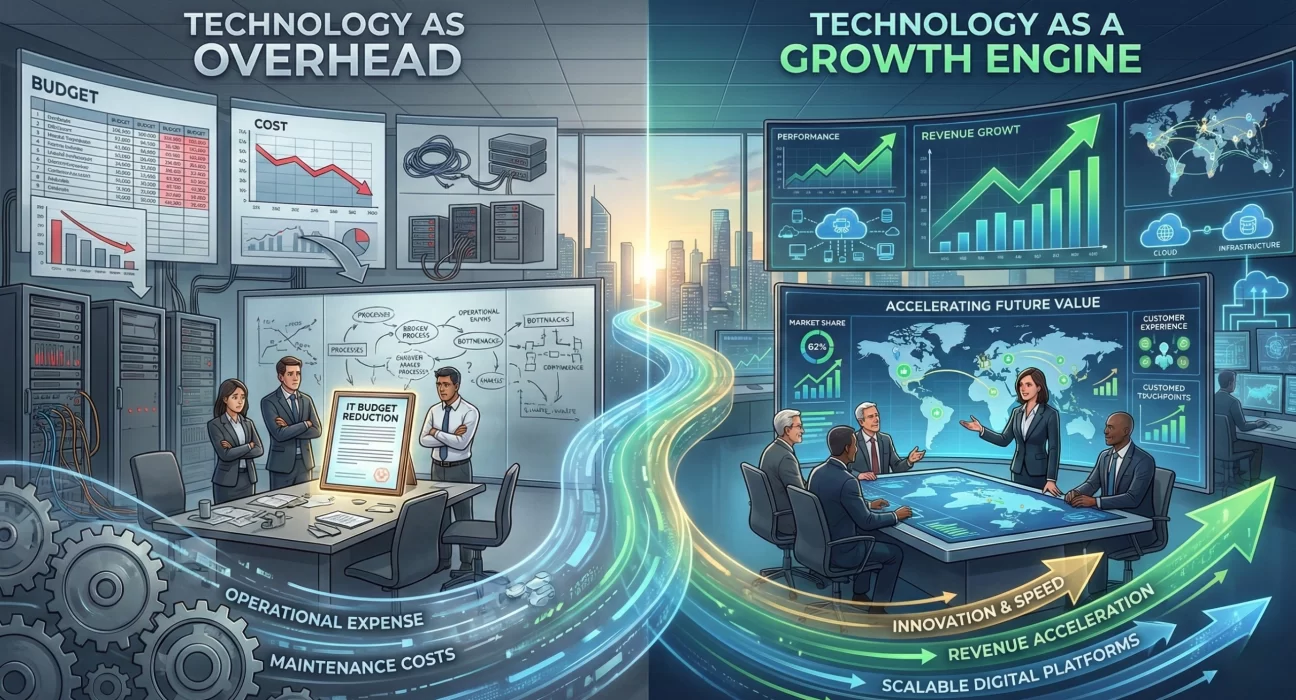
For most large enterprises, technology spending sits in an uncomfortable place. Finance teams see it as overhead. Business units see it as necessary friction. Executives know it matters, but struggle to connect the investment to measurable business outcomes beyond “keeping the lights on.”
This framing problem is not just semantic. It shapes how technology decisions get made, how programs get funded, and ultimately whether technology becomes a competitive advantage or a source of ongoing frustration.
The traditional view treats technology as something you buy to support the business. You need email systems, ERP platforms, CRM tools, security infrastructure. These are costs of doing business, much like rent or utilities. The goal becomes minimizing spend while maintaining acceptable service levels.
This mindset made sense in an era when technology was genuinely peripheral to most business operations. But that era ended years ago. Today, technology is embedded in customer experience, operational efficiency, product delivery, market responsiveness, and competitive positioning. Yet many enterprises still manage technology investments with the same frameworks built for cost containment rather than value creation.
The result is predictable. Technology programs get underfunded or funded inconsistently. They get evaluated on cost reduction rather than business impact. They attract less senior attention during planning and more scrutiny when things go wrong. Teams operate defensively, focused on risk avoidance rather than opportunity capture.
This creates a vicious cycle. When technology is framed as cost, it receives cost-focused management. When it receives cost-focused management, it delivers cost-focused outcomes. And when it delivers cost-focused outcomes, it reinforces the original framing.
Why Scale Makes This Harder
The framing problem intensifies at enterprise scale for several specific reasons.
First, technology spending becomes diffuse and hard to track. A global enterprise might have hundreds of active technology initiatives across regions, business units, and functional areas. Some are large transformation programs. Others are smaller improvements or maintenance work. Finance can see the aggregate spend, but connecting that spend to specific business outcomes requires visibility that most enterprises lack.
Second, the relationship between technology investment and business performance operates on different timelines. A sales team can connect marketing spend to pipeline generation within weeks. Technology programs, especially large ones, often require months or years before business impact becomes measurable. This timing mismatch makes it harder to demonstrate value and easier to question whether the investment was worth it.
Third, enterprise technology environments are complex and interdependent. Improving customer experience might require changes to the website, the order management system, the fulfillment platform, and the customer service tools. Isolating which investment drove which outcome becomes genuinely difficult. This complexity provides cover for questioning any specific investment while making it harder to defend the overall technology budget.
Fourth, most large enterprises have accumulated technical debt and aging infrastructure that requires ongoing investment just to maintain current capability. This maintenance work is essential but rarely exciting. It is hard to frame “preventing systems from breaking” as a growth initiative, even though system failures would immediately damage revenue and reputation.
The combination of these factors means that technology spending at enterprise scale naturally drifts toward being viewed as overhead unless deliberate effort goes into framing and managing it differently.
Shifting the Frame
Reframing technology from cost center to growth engine requires changing how investments get evaluated, how programs get structured, and how outcomes get measured.
The starting point is connecting technology investments directly to specific business outcomes that matter to the executive team. Not generic outcomes like “improved efficiency” but concrete results like reducing customer acquisition cost by 15%, cutting order fulfillment time from 48 hours to 24 hours, or enabling entry into a new market segment.
This sounds obvious, but most enterprise technology programs begin with technical objectives rather than business objectives. The goal becomes “migrate to cloud” or “implement new CRM” rather than “enable sales team to close deals 20% faster” or “reduce infrastructure cost by $3M annually while improving reliability.”
Starting with business outcomes changes everything. It changes who gets involved in planning. It changes how success gets measured. It changes how the program gets funded and how much patience exists when challenges emerge.
It also requires being honest about which technology investments genuinely drive growth and which ones are necessary maintenance. Both matter, but they require different conversations. Attempting to frame every technology investment as transformational damages credibility and makes it harder to secure support for initiatives that actually will transform something.
The second shift involves structuring programs for demonstrable progress rather than big-bang delivery. Enterprise technology initiatives often fail not because the end goal was wrong but because the path to get there was too long, too risky, or too disconnected from ongoing business needs.
Breaking large programs into stages that each deliver measurable value makes it easier to maintain momentum, adjust direction based on learning, and demonstrate that the investment is producing returns before the entire program completes. This approach also reduces risk, which matters enormously at enterprise scale where a failed $50M program does real damage.
The third shift is improving visibility into what technology investments are actually producing. Most enterprises cannot easily answer questions like “what did we spend on customer experience technology last year?” or “which initiatives delivered measurable ROI?” Without this visibility, technology spending remains a black box that naturally attracts skepticism.
Where Execution Becomes Critical
Reframing is necessary but not sufficient. The frame only holds if execution actually delivers the outcomes. This is where many enterprises struggle.
Large technology programs face predictable challenges. Requirements are complex and often unclear at the start. Stakeholders have competing priorities. Technical environments are complicated. Teams include people from multiple organizations with different incentives. Timelines stretch and budgets expand.
These challenges are real, but they are also solvable with the right approach to program structure and delivery accountability.
What changes outcomes is having genuinely senior people accountable for delivery, not just oversight. In many enterprise programs, experienced leaders provide governance while execution gets delegated to teams that lack the authority to make hard decisions when conflicts emerge. This creates escalation bottlenecks that slow everything down.
Having partners who put senior people directly into delivery roles changes the dynamic. When the person running daily standups is the same person who can authorize a change in technical approach or resolve a stakeholder conflict, decisions happen faster and problems get addressed before they become crises.
This is how Ozrit approaches enterprise work. Programs are led by people with 15-20 years of experience who take direct accountability for delivery. Not as advisors or reviewers, but as active participants who own outcomes. This level of involvement matters because it eliminates layers of communication and decision-making that typically slow enterprise programs.
Equally important is team composition and onboarding discipline. Enterprise programs often struggle because team members lack context about the business, the technical environment, or the political landscape. They spend months learning what they need to know while the program drifts.
Ozrit addresses this through structured onboarding that gets teams productive faster. New team members receive direct exposure to business context, technical architecture, and key stakeholders before they begin active work. This investment in context reduces the common pattern where the first three months of a program produce limited value while everyone figures out what they are supposed to be doing.
The firm maintains a bench of about 150 experienced professionals, which provides flexibility to scale teams up or down as programs evolve without compromising on quality or experience level. This capacity matters for enterprise clients who need confidence that they can accelerate when needed without sacrificing delivery standards.
Realistic timelines also matter. Many enterprise programs fail because they were planned with aggressive timelines that had no basis in reality. Building a detailed, defendable project plan takes time, but that investment prevents far more expensive problems later. Ozrit typically spends 4-6 weeks on detailed planning before active development begins, which leads to more predictable delivery and fewer surprises.
For enterprises running global operations, 24/7 support availability reduces risk when systems are live. Having access to experienced people who understand the architecture and can respond to production issues quickly prevents small problems from becoming business-impacting incidents.
Making the Transition
Shifting how an enterprise thinks about technology spending does not happen through a single decision or announcement. It happens through a series of programs that demonstrate different results than what came before.
The pattern that works is starting with initiatives where the connection between technology investment and business outcome is clear and measurable. These become proof points that make it easier to secure support for more ambitious programs later.
It also requires building relationships between technology leaders and business leaders based on delivery rather than promises. Business executives become willing to view technology as strategic when they see technology teams consistently deliver what they commit to, on timelines that make sense, with transparency about progress and challenges.
This is fundamentally about execution credibility. Enterprises that successfully reframe technology spending as growth investment do so because they can point to specific programs that produced specific results within specific timeframes. The reframing becomes believable because the evidence exists to support it.
The Underlying Reality
Technology spending at large enterprises will either drive competitive advantage or it will not. There is no neutral position where technology is just a cost of doing business. Competitors are using technology to move faster, serve customers better, operate more efficiently, and enter new markets. Standing still is actually falling behind.
The question is not whether to invest in technology but whether those investments will be structured, managed, and executed in ways that produce real business value. This requires clear thinking about outcomes, honest assessment of capability, and disciplined execution.
For enterprises willing to make that shift, technology moves from being a source of anxiety and budget pressure to being a genuine source of competitive strength. That transition is not easy, but it is increasingly necessary.