

Not dramatically. Just enough that your month-end close process, the one that took eighteen months to stabilise, now requires manual intervention. Again. Your finance team will spend the next three weekends rebuilding reports. Your compliance officer is asking whether the audit trail still meets the standard. And your technology head is explaining why the system that cost ₹40 crores can’t simply adjust to a three-column change in a regulatory filing.
If you operate in banking, insurance, pharmaceuticals, healthcare, or any sector where regulators have real power, this story is familiar. You’re not just building enterprise systems. You’re building enterprise systems that must satisfy requirements that change without warning, that are sometimes ambiguous, and that carry penalties for non-compliance that can shut down business lines.
The challenge isn’t technology. The challenge is building systems that can absorb regulatory change without breaking your operations or your budget every time the rules shift.
Why Regulatory Systems Are Different
Let’s be clear about what makes regulatory-heavy industries harder.
In most enterprise software programs, requirements come from your business. You control the roadmap. If priorities change, you adjust. If a feature can wait, it waits. You’re optimising for efficiency, user experience, and business value.
In regulated industries, a significant portion of your requirements comes from outside your organisation. The Reserve Bank of India updates its master direction on digital lending. SEBI revises disclosure norms for mutual funds. The Insurance Regulatory and Development Authority introduces new solvency requirements. The Ministry of Health and Family Welfare changes hospital reporting standards.
You don’t get to decide whether to implement these changes. You don’t get to push them to next quarter. You implement them, on time, correctly, with a full audit trail, or you face penalties, public censure, or loss of license.
This fundamentally changes how you think about system design.
Your architecture must assume that external requirements will change frequently and unpredictably. Your data models must accommodate fields and validations you didn’t anticipate. Your reporting layer must generate outputs in formats specified by regulators, not by your business analysts. And your audit trail must prove not just what happened, but why it happened, who approved it, and when, because that’s what the examiner will ask for.
The Systems That Fail
Most enterprise systems in regulated industries fail the same way. Not catastrophically. Gradually.
They launch. They work. Then the first regulatory change arrives.
The change seems minor. A new field on a form. A different calculation method for a ratio. An additional approval step in a workflow. Small enough that someone says, “We can handle this with a quick patch.”
So you patch it. It works. Until the second change arrives. Then the third. Each time, you patch. Each time, the system becomes a little more fragile. A little harder to test. A little more dependent on manual workarounds.
Two years in, you have a system that technically meets regulatory requirements but has become unmaintainable. The original developers have moved on. The documentation doesn’t match the actual system. No one is quite sure which parts of the code handle which regulations. And when the next major regulatory shift comes, because it always comes, your options are either a massive remediation program or starting over.
This isn’t a technology failure. It’s a design failure.
The system was built to meet today’s regulations. It wasn’t built to absorb tomorrow’s regulations without breaking.
What Actually Goes Wrong
Let’s talk about specific failure patterns, because recognising them is the first step to avoiding them.
Hard-coded compliance logic. Your developers embed regulatory rules directly into application code. Interest rate calculations, eligibility criteria, and risk weightings are all coded into the system. When the rules change, you’re rewriting code, retesting everything, and hoping you didn’t break something else. This approach works until the first regulatory change. Then it becomes expensive and risky.
Fragile integrations. Your regulatory reporting pulls data from six different systems. Each system was built independently. The integration layer is custom code written by consultants who are no longer available. When one of those systems gets upgraded or when the regulator changes the reporting format, the integration breaks. You discover this three days before the filing deadline.
Undocumented workarounds. Somewhere in your organisation, someone has a spreadsheet. It takes data from the system, applies corrections, and produces the actual regulatory filing. This spreadsheet is maintained by one person. It’s not version-controlled. It’s not tested. It’s not included in your disaster recovery plan. And it’s absolutely critical to your compliance. You know this is a problem. You’ve known for two years. But fixing it properly would require changes to three core systems and coordination across four business units, so the spreadsheet survives.
Audit trail gaps. Your system captures transactions. But it doesn’t capture why decisions were made, who approved exceptions, or what calculations were performed. When the auditor asks to trace a specific transaction from origination through final reporting, you can’t produce a clean trail. You end up reconstructing it from emails, manually compiled logs, and institutional memory. This works until the person with the institutional memory leaves.
Testing that doesn’t test compliance. Your QA team tests whether the system functions. They don’t test whether it meets regulatory requirements, because they don’t have the regulatory expertise. Your compliance team understands the requirements but doesn’t have the technical capability to test system behaviour. So you launch, discover compliance gaps in production, and fix them under time pressure.
These aren’t edge cases. These are the default failure modes for enterprise systems in regulated industries.
The Design Principles That Matter
The systems that survive regulatory change and there are some share certain design characteristics.
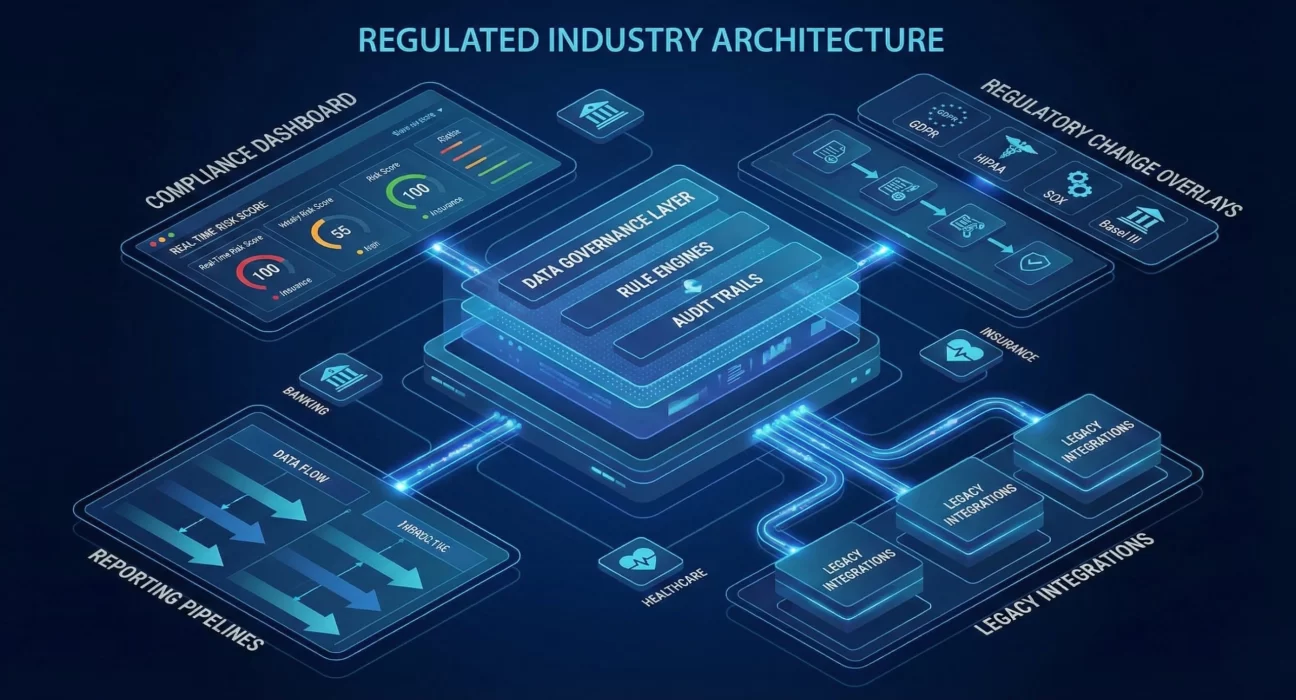
Externalised compliance logic. Rules that change frequently shouldn’t live in application code. They should live in a configuration that can be updated without redeployment. Interest rates, fee structures, eligibility criteria, calculation methods, anything a regulator might change should be data, not code. This doesn’t mean you avoid all code changes. It means you avoid code changes for routine regulatory updates.
Single source of regulatory truth. Every piece of data required for regulatory reporting should have one authoritative source within your enterprise. Not three systems that might have slightly different values. Not six spreadsheets that need to be manually reconciled. One source. With clear ownership. With defined data quality standards. With an audit trail. When the regulator asks where a number came from, you should be able to answer definitively, not probably.
Versioned compliance data. Regulations change, but your historical data doesn’t. You need to know not just what the current rule is, but what the rule was on any historical date. Because auditors ask questions about transactions from eighteen months ago, and you need to prove that your system applied the correct rule as of that date. This means your data models must version regulatory logic and maintain clear, effective dates.
End-to-end traceability. From the moment a transaction enters your system to the moment it appears on a regulatory filing, you must be able to trace every transformation, every calculation, every decision. Not just for debugging. For audit. This isn’t optional. It’s the price of operating in a regulated industry. If you can’t prove what happened, you can’t prove compliance.
Separation of business and compliance logic. Your business rules change because your business changes. Your compliance rules change because regulators change them. These are different rhythms, different stakeholders, different approval processes. If they’re tangled together in the same code, every business change carries compliance risk, and every compliance change risks breaking business functionality. Separate them. Different modules, different governance, different deployment cycles.
The Execution Challenge
Good design principles are necessary but not sufficient. You still have to execute the program.
And execution in regulatory-heavy industries is harder because the stakes are higher and the margin for error is lower.
You can’t launch with known gaps. In most enterprise software, you can launch with a minimal viable product and iterate. In regulated industries, you must launch compliant. Day one. Because day one is when regulatory obligations begin. You can’t tell the regulator you’ll be fully compliant by month three. Either you’re compliant, or you’re not operating.
You can’t afford to be wrong about interpretation. Regulatory requirements are often written in legal language that leaves room for interpretation. Your compliance team interprets it one way. Your auditor might interpret it differently. And the regulator’s interpretation is the only one that matters. Getting this wrong means rework at best, enforcement action at worst. This means your program must include early and ongoing engagement with compliance, legal, and sometimes the regulator itself, not just IT and the vendor.
You can’t ignore legacy systems. Your new regulatory reporting system needs data from that core banking platform you’ve been trying to retire for five years. Or that policy administration system running on infrastructure that the vendor no longer supports. You can’t simply replace everything. You have to integrate, which means understanding systems that may be poorly documented and maintained by people who weren’t around when they were built.
You can’t skip change management. Your users aren’t just learning a new system. They’re learning new processes that must be followed precisely because compliance depends on it. Training isn’t optional. Process documentation isn’t optional. Clear escalation paths when something doesn’t work aren’t optional. Because if your users work around the system even for good reasons, you’ve lost control of compliance.
This is where enterprise program management capability becomes critical. Not project management. Program management. The discipline of coordinating multiple workstreams, managing multiple stakeholders, anticipating risks before they materialise, and maintaining forward momentum even when obstacles appear.
Partners who understand these firms, like Ozrit, that have delivered complex programs in regulated environments, bring more than technical skills. They bring pattern recognition. They’ve seen what breaks. They know which shortcuts create technical debt and which are pragmatic. They know how to structure governance so that decisions happen quickly enough to keep programs moving. They know how to manage stakeholders who have conflicting priorities but equal authority.
What Leadership Needs to Own
If you’re the executive sponsoring a major system implementation in a regulated industry, certain responsibilities sit with you. Not with your CTO. Not with your vendor. With you.
Clear accountability. Who owns compliance? Not compliance as a function, you have a chief compliance officer for that. Who is responsible for ensuring that the system meets regulatory requirements? If the answer is “it’s shared between IT and compliance,” you have a problem. Shared accountability is no accountability. One person must own the outcome. When something goes wrong, and something will go wrong, who gets the call?
Regulatory engagement strategy. How are you managing your relationship with the regulator during this program? Are you seeking advanced guidance on requirements? Are you demonstrating your approach before you build the entire system? Or are you building first and hoping the regulator agrees with your interpretation? The wrong approach here can cost you months of rework.
Realistic timelines. Regulatory deadlines are fixed. But that doesn’t mean your implementation timeline should be set by working backwards from a regulatory deadline and assuming everything goes perfectly. Things don’t go perfectly. Your timeline must include a buffer for issues, for regulatory interpretation discussions, and for testing that reveals gaps. If you’re starting an eighteen-month program with a regulatory go-live date eighteen months away, you’re already late.
Investment in sustainability. Building the system is one program. Maintaining it through years of regulatory change is a different commitment. That means investing in documentation, in knowledge transfer, in skills development for your team, in vendor relationships that extend beyond implementation. If your business case only covers initial build costs, you’re underfunding the actual requirement.
Honest risk assessment. What could go wrong? Not the sanitised version for the board deck. The real version. What if the vendor delivers late? What if your data quality is worse than you think? What if the regulator changes requirements mid-program? What if key people leave? You need mitigation plans for realistic risks, not just the comfortable assumption that everything will work out.
These aren’t technology questions. They’re leadership questions. And they determine whether your program succeeds or becomes another expensive lesson in what not to do.
The Questions That Reveal Readiness
Before you commit significant budget and organisational energy to a regulatory system implementation, ask these questions. The quality of the answers will tell you whether you’re ready.
Can we produce a complete regulatory filing from our current systems without manual intervention? If the answer is no if there are spreadsheets, if there’s manual reconciliation, if judgment calls are happening outside the system, then your current state is more fragile than you think. And building something new without addressing those gaps means you’re just moving the fragility into the new system.
Do we know which of our requirements come from regulation versus which come from our interpretation of regulation? This distinction matters. Regulatory requirements are fixed. Your interpretation might be negotiable. If you’ve conflated the two, you might be over-engineering the solution or making it inflexible in ways that don’t actually serve compliance.
When the last major regulatory change happened, how long did it take us to implement, and what broke? This tells you about your organisation’s change absorption capacity. If the last regulatory change took six months and broke three downstream processes, that’s your baseline. The new system needs to improve on that, not just replicate it.
Who in our organisation has actually read the relevant regulations, not just summaries of them? Compliance systems fail when they’re built to someone’s summary of requirements rather than the actual requirements. The original regulatory text is dense, legalistic, and boring. But it’s also precise. If no one on your program team has read it, you’re building on assumptions.
What happens if we’re wrong? Not a hypothetical. What’s the actual penalty for non-compliance in your specific regulatory context? Is it a fine? A public censure? Suspension of license? Criminal liability for executives? Understanding the downside shapes how much you should invest in getting it right.
Building Systems That Last
The difference between a system that survives and a system that becomes legacy isn’t age. It’s adaptability.
A ten-year-old system that has absorbed thirty regulatory changes without accumulating technical debt is an asset. A three-year-old system that requires major rework every time requirements change is a liability.
Adaptability comes from design, but also from discipline.
You need technical architecture that separates concerns, externalises rules, and maintains clean audit trails. But you also need organisational discipline to actually use that architecture correctly. To resist the temptation to patch quickly instead of fixing properly. To maintain documentation even when timelines are tight. To invest in automated testing, even though it seems expensive. To say no to workarounds even when they solve immediate problems.
This discipline is hard to sustain. It requires ongoing commitment from leadership. It requires vendors and partners who prioritise long-term maintainability over short-term delivery. It requires governance that treats system health as seriously as feature delivery.
And it requires honest assessment of when you’re accumulating technical debt versus making pragmatic trade-offs. Some shortcuts are worth taking. Some create problems that compound over time. Knowing the difference requires experience, either your own or your partner’s.
The Path Forward
If you’re leading an organisation that needs to build or replace regulatory systems, you’re not facing a technology problem. You’re facing an execution problem in a high-stakes environment.
The technology exists. Cloud platforms, modern data architectures, configurable rules engines, sophisticated reporting tools, these are mature and available. The challenge is assembling them into a solution that works for your specific regulatory context, your specific legacy environment, and your specific organisational constraints.
That assembly requires judgment. It requires trade-offs. It requires a deep understanding of both the regulatory requirements and the practical realities of enterprise IT.
It requires partners who have done this before. Who understands that compliance isn’t a feature you add at the end? Who knows how to structure programs so that regulatory, legal, IT, and business stakeholders can actually work together instead of creating conflicts. Who can help you make the right trade-offs between perfect architecture and practical delivery.
When Ozrit engages with enterprises in regulated industries, the first conversation isn’t about the technology stack. It’s about risk. What are you most worried about? Where have similar programs failed in your industry? What constraints are non-negotiable? What regulatory relationships are sensitive? From those answers, the program structure emerges not from a template, but from understanding your specific context.
This isn’t the only way to approach regulatory system implementation. But it’s the way that reduces the likelihood of expensive surprises halfway through the program.
The Real Cost of Getting This Wrong
Budget overruns in regulatory programs get management attention. But they’re not the real cost.
The real cost is operational. It’s your finance team working weekends every quarter because the system can’t produce clean regulatory reports. It’s your compliance team maintaining shadow systems because they don’t trust the official system. It’s business opportunities you can’t pursue because your systems can’t handle the regulatory requirements of new products or new markets.
The real cost is strategic. It’s the competitor who can launch new offerings in weeks because their systems are flexible, while you need months because yours aren’t. It’s the acquisition you can’t integrate because your regulatory systems can’t absorb their data. It’s the digital transformation program you can’t start because your compliance systems are too fragile to change.
The real cost is risk. It’s the audit finding that reveals gaps in your controls. It’s the regulatory examination that uncovers inconsistencies in your reporting. It’s the realisation that you can’t actually prove compliance for transactions from two years ago because your audit trail has gaps.
These costs don’t appear on project budgets. They accumulate over the years. They constrain your business in ways that become invisible because you stop even considering options that your systems can’t support.
Getting regulatory systems right isn’t about avoiding short-term pain. It’s about building long-term capability.
Moving Forward
Regulatory complexity isn’t decreasing. If anything, it’s accelerating. More requirements. More detail. More frequent changes. More coordination across jurisdictions.
Your systems need to keep pace. Not just today, but for the next decade.
That means building differently. Designing for change, not for current requirements. Investing in maintainability, not just initial delivery. Partnering with organisations that understand enterprise realities, not just enterprise technology.
It means treating system implementation as a strategic program, not a tactical project. With appropriate governance. With clear accountability. With honest risk management. With leadership engagement that extends beyond approval and into active stewardship.
And it means recognising that the expertise required to deliver successfully isn’t just technical. It’s regulatory. It’s operational. It’s organisational. It’s the accumulated experience of having done this before, in contexts similar to yours, with stakes as high as yours.
This kind of delivery is hard. It should be hard. The systems you’re building are critical to your ability to operate. Getting them right matters.
But hard doesn’t mean impossible. It means you need the right approach, the right discipline, and the right partners.
Get those things right, and you can build regulatory systems that don’t just meet today’s requirements. You can build systems that absorb tomorrow’s requirements without breaking your operations or your budget.