
Low-code platforms have been marketed as the solution to every enterprise’s backlog problem. Build applications faster. Empower citizen developers. Reduce dependency on IT. The promise is compelling. The reality is more complex.
Indian enterprises, in particular, face a difficult choice. Legacy systems need modernisation. IT budgets are under pressure. Development backlogs stretch into years. Low-code platforms seem like the obvious answer until they’re not.
The question isn’t whether low-code has a place in enterprise automation. It does. The real question is where it fits, how it’s governed, and what happens when initial enthusiasm meets operational reality.
The Low-Code Promise and the Enterprise Reality
Low-code platforms promise speed. Drag-and-drop interfaces. Pre-built components. Faster time-to-market. For simple workflows and departmental tools, this often works exactly as advertised.
But enterprise automation is rarely simple.
Simple applications don’t stay simple. What starts as a basic approval workflow soon needs integration with SAP, compliance audit trails, role-based access controls, and mobile access. The low-code platform that handled version one struggles with version three.
Citizen development sounds empowering until it creates chaos. Business users building their own applications can innovate quickly. They can also create security vulnerabilities, duplicate functionality across departments, and build tools that don’t scale beyond their immediate team.
Platform lock-in is real and expensive. Moving an application built entirely on one low-code platform to another or to custom code is often harder than building from scratch. Enterprises discover this when they want to exit a platform, change vendors, or scale beyond platform limitations.
Governance becomes the bottleneck. Without proper controls, low-code sprawl mirrors the Excel sprawl that enterprises spent years trying to eliminate. Critical business processes running on unmanaged, undocumented applications maintained by people who’ve moved to other roles.
Where Low-Code Actually Works in Enterprises
Low-code isn’t inherently good or bad. It’s a tool. Like any tool, success depends on using it for the right jobs.
Internal process automation with stable requirements. Employee onboarding workflows. Leave approval systems. Asset request management. These are predictable, well-understood processes where speed matters more than architectural flexibility.
Prototyping and proof-of-concept work. Before committing to full-scale development, low-code platforms let enterprises validate ideas quickly. Build a prototype, test with users, learn what works, then decide whether to rebuild properly or stick with the low-code version.
Departmental tools with limited integration needs. Marketing campaign trackers. Sales pipeline dashboards. HR feedback tools. If the application doesn’t need deep integration with core systems and serves a specific team, low-code can deliver value without creating enterprise risk.
Time-bound initiatives with short lifecycles. A one-time product launch campaign. A temporary compliance reporting tool. Applications that will be retired after six months don’t need enterprise-grade architecture. Low-code speed makes sense.
What doesn’t work? Using low-code for mission-critical systems, customer-facing applications, or anything requiring complex business logic, high transaction volumes, or deep integration with legacy systems.
The Governance Challenge Nobody Talks About
The dirty secret of enterprise low-code adoption is that governance overhead often eliminates the speed advantage.
Without governance, you get shadow IT at scale. Business teams spin up applications without IT oversight. Six months later, IT discovers that finance is running a critical reconciliation process on a low-code app that has no backup, no security review, and no disaster recovery plan.
With heavy governance, you lose the speed benefit. If every low-code application needs the same security review, architecture approval, and deployment process as custom development, what’s the point? You’ve traded one bottleneck for another.
The balance is hard to find. Mature enterprises create tiered governance light-touch for low-risk departmental tools, rigorous oversight for anything touching customer data, financials, or regulated processes. But defining and enforcing these tiers requires discipline most organisations lack.
Accountability remains unclear. Who owns a low-code application built by a business analyst who’s now in a different role? Who maintains it when the original creator leaves? Who ensures it still complies with data privacy regulations two years after deployment?
Integration: Where Low-Code Hits Enterprise Reality
Integration is where low-code’s simplicity promise collides with enterprise complexity.
Pre-built connectors rarely cover enterprise needs. Low-code platforms advertise hundreds of integrations. But enterprises don’t run on standard configurations. They run customised ERP instances, bespoke CRM setups, and legacy systems that predate modern APIs.
Real-time integration exposes platform limitations. Batch uploads and scheduled syncs work for reporting tools. They don’t work for order management systems that need real-time inventory updates or customer service platforms that need live access to transaction history.
Legacy system integration requires expertise that low-code can’t replace. Connecting to a mainframe requires understanding protocols, data formats, and business logic that no drag-and-drop interface can abstract away. You still need developers who understand the underlying systems.
Data consistency becomes a nightmare. When business users build applications that create, update, or delete data in core systems, maintaining referential integrity across platforms becomes nearly impossible. One team’s low-code app inadvertently corrupts data that another system depends on.
This is why enterprises increasingly rely on partners who understand both low-code capabilities and enterprise integration realities. Organisations like Ozrit help navigate these complexities not by avoiding low-code, but by knowing when it fits and how to integrate it properly within broader enterprise architecture.
The Hidden Costs of Low-Code at Scale
Low-code platforms promise cost savings. In practice, costs often shift rather than disappear.
Licensing models penalise success. Per-user or per-transaction pricing means that successful applications become expensive. An approval workflow that costs ₹50,000 a year for 50 users costs ₹5 lakhs when rolled out to 500 users. At scale, custom development might have been cheaper.
Platform upgrades break applications. Low-code vendors release updates that change functionality, deprecate features, or introduce breaking changes. Applications built six months ago suddenly need rework. Someone has to manage this and that someone is usually an expensive developer.
Skills aren’t transferable. Training staff on a proprietary low-code platform creates skills that only work on that platform. If the enterprise changes platforms or moves away from low-code, that training investment is lost.
Technical debt accumulates faster. Because low-code makes it easy to build quickly, organisations build more. But they don’t invest in documentation, testing, or proper architecture. Within two years, they have dozens of fragile applications that nobody fully understands.
When to Choose Custom Development Over Low-Code
Low-code isn’t always the right choice. Sometimes, traditional development is faster, cheaper, and more sustainable.
Complex business logic requires code. If your process involves conditional logic with dozens of variables, calculation engines, or sophisticated workflow orchestration, custom development gives you control and flexibility low-code can’t match.
High-volume transaction processing needs performance. Low-code platforms work for hundreds of transactions a day. They struggle with thousands per hour. If performance at scale matters, custom development is non-negotiable.
Long-term strategic systems deserve proper architecture. Core business systems ERP, CRM, supply chain management should not be built on low-code platforms. These systems need to last 10-15 years, evolve continuously, and handle enterprise-scale complexity.
Customer-facing applications require full control. Anything customers interact with directly mobile apps, web portals, API services needs design flexibility, performance optimisation, and brand consistency that low-code platforms constrain.
Making Low-Code Work: What Mature Enterprises Do Differently
Enterprises that successfully use low-code share common practices.
They define clear boundaries. Low-code for internal tools and departmental automation. Custom development for core systems and customer-facing applications. No exceptions, no matter how urgent the business needs.
They enforce platform standards. Rather than letting each department choose their own low-code platform, they standardise on one or two. This reduces integration complexity, consolidates licensing, and makes governance manageable.
They require proper handover processes. No low-code application goes into production without documentation, designated ownership, and a maintenance plan. If the creator leaves, someone else can support it.
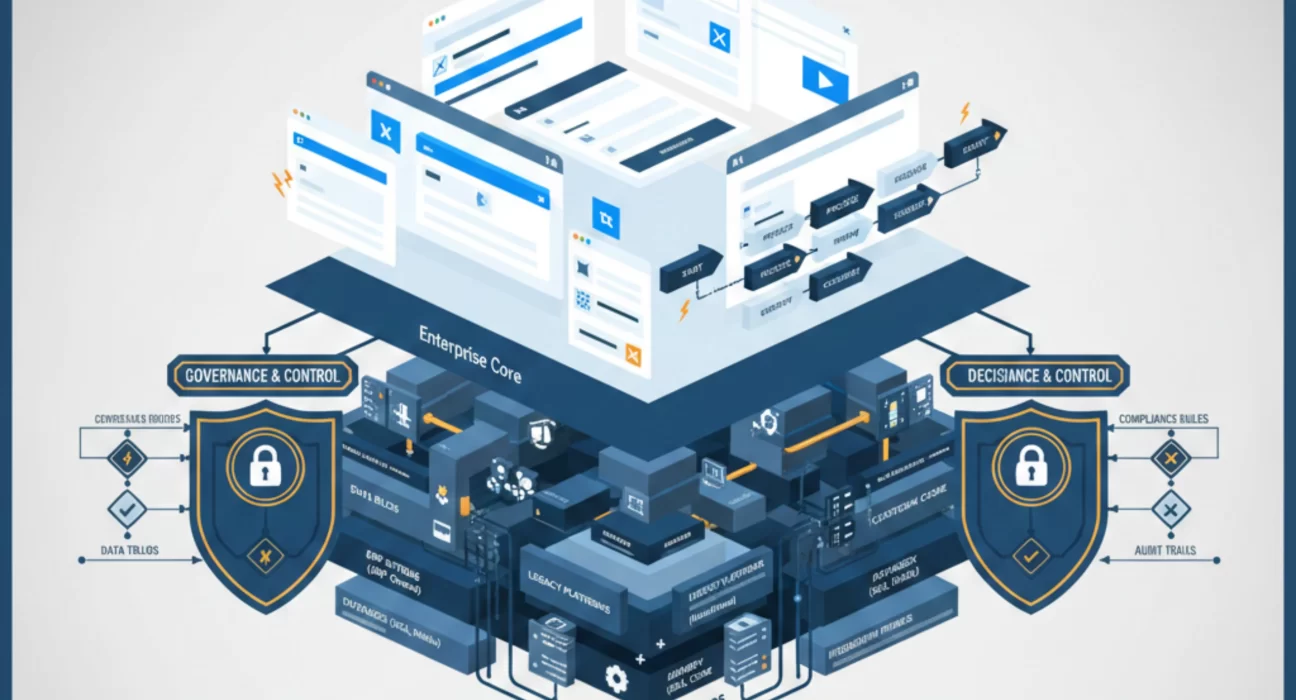
They integrate low-code into enterprise architecture. Low-code applications don’t live in isolation. They’re documented in enterprise architecture, integrated with existing systems through approved patterns, and subject to the same security and compliance reviews as any other system.
They measure total cost of ownership, not just initial delivery cost. A low-code application that takes two weeks to build but costs ₹10 lakhs a year to maintain and license might be more expensive over three years than a custom solution that takes three months to build but costs ₹2 lakhs annually to run.
The Role of Leadership in Low-Code Governance
Low-code success requires leadership commitment to governance discipline.
CIOs must resist pressure to bypass standards. When a business unit wants to deploy a low-code app quickly and argues that governance is slowing them down, the easy path is to make an exception. Mature CIOs hold the line. Exceptions become norms, and norms create chaos.
CFOs must look beyond initial savings. Low-code can reduce upfront development costs. But if it increases licensing costs, creates integration overhead, or results in applications that need replacement in three years, it’s not actually cheaper. Total cost of ownership analysis is essential.
COOs must balance speed with sustainability. Operations leaders want tools deployed quickly. But tools that break, don’t integrate, or can’t scale create operational risk. Better to wait an extra month for a solution that will work reliably for years.
CEOs must set the tone on technical debt. When leadership celebrates rapid deployment without asking about long-term sustainability, organisations optimise for short-term wins at the expense of institutional capability. The message from the top matters.
Hybrid Strategies: Combining Low-Code with Custom Development
The most successful enterprises don’t treat low-code and custom development as either-or choices. They use both strategically.
Low-code for front-end interfaces, custom code for back-end logic. Use low-code to build user-friendly forms and dashboards. Handle complex processing, integrations, and data management with custom code. This gives speed where it matters and control where it’s needed.
Low-code for prototyping, custom development for production. Build quickly with low-code to validate requirements and test with users. Once proven, rebuild with proper architecture for production deployment.
Low-code for temporary solutions, migration plans for long-term. When there’s urgent business need and custom development will take months, low-code can fill the gap. But with a clear plan to replace it with a sustainable solution within a defined timeframe.
This hybrid approach requires mature program management and delivery partners who understand both worlds. Partners like Ozrit help enterprises navigate these decisions—not pushing low-code or custom development as universal solutions, but applying the right approach for each specific context.
The Sustainability Question
The ultimate test of any technology choice is sustainability. Will this solution still work, still be supportable, and still deliver value three years from now?
Platform viability matters. Low-code vendors get acquired, change pricing models, or sunset products. Betting critical business processes on a platform requires confidence in the vendor’s long-term viability.
Skills availability matters. If your low-code applications require specialists in a niche platform, what happens when they leave? Can you hire replacements? Can you train existing staff? Or are you locked into expensive consultants?
Evolution capability matters. As business requirements change, can your low-code applications evolve? Or will you hit platform limitations that force a complete rebuild?
Exit strategy matters. If you need to move away from a low-code platform due to cost, capability limits, or vendor issues what’s the migration path? Can you extract your business logic? Can you rebuild elsewhere? Or are you trapped?
What Enterprises Should Demand from Low-Code Vendors
Not all low-code platforms are created equal. Enterprises should evaluate based on enterprise realities, not marketing claims.
Demand realistic integration capabilities. Ask for proof, not promises. Can the platform integrate with your specific ERP configuration, your legacy systems, your security infrastructure? Request pilot integrations before committing.
Demand transparent pricing at scale. Understand exactly what happens to costs as user counts grow, transaction volumes increase, and you add environments for development, testing, and production. Hidden costs appear in year two.
Demand governance and lifecycle management tools. Can you track which applications exist? Can you enforce security policies centrally? Can you manage version control and deployments properly? Governance can’t be an afterthought.
Demand proof of long-term sustainability. Ask for customer references who’ve been using the platform for 3+ years at scale. Ask about upgrade paths, platform evolution, and backward compatibility. Evaluate the vendor’s financial stability and commitment to the product.
Final Thoughts: Pragmatism Over Hype
Low-code platforms are useful tools. They’re not miracle solutions.
Used thoughtfully for the right use cases, with proper governance, and realistic expectations they can accelerate specific types of enterprise automation. Used carelessly, they create technical debt, vendor lock-in, and operational risk.
The enterprises that succeed with low-code are those that treat it as one tool among many, not a replacement for software engineering discipline. They invest in governance. They set clear boundaries. They measure the total cost of ownership. They plan for sustainability.
Most importantly, they partner with organisations that understand enterprise program execution partners who can help navigate the trade-offs between speed and sustainability, between business agility and technical robustness.
Enterprise automation with low-code platforms works when it’s approached with the same execution discipline, governance maturity, and accountability standards as any other enterprise technology initiative.
Anything less is just optimism meeting complexity. And in enterprise software delivery, optimism is never enough.