

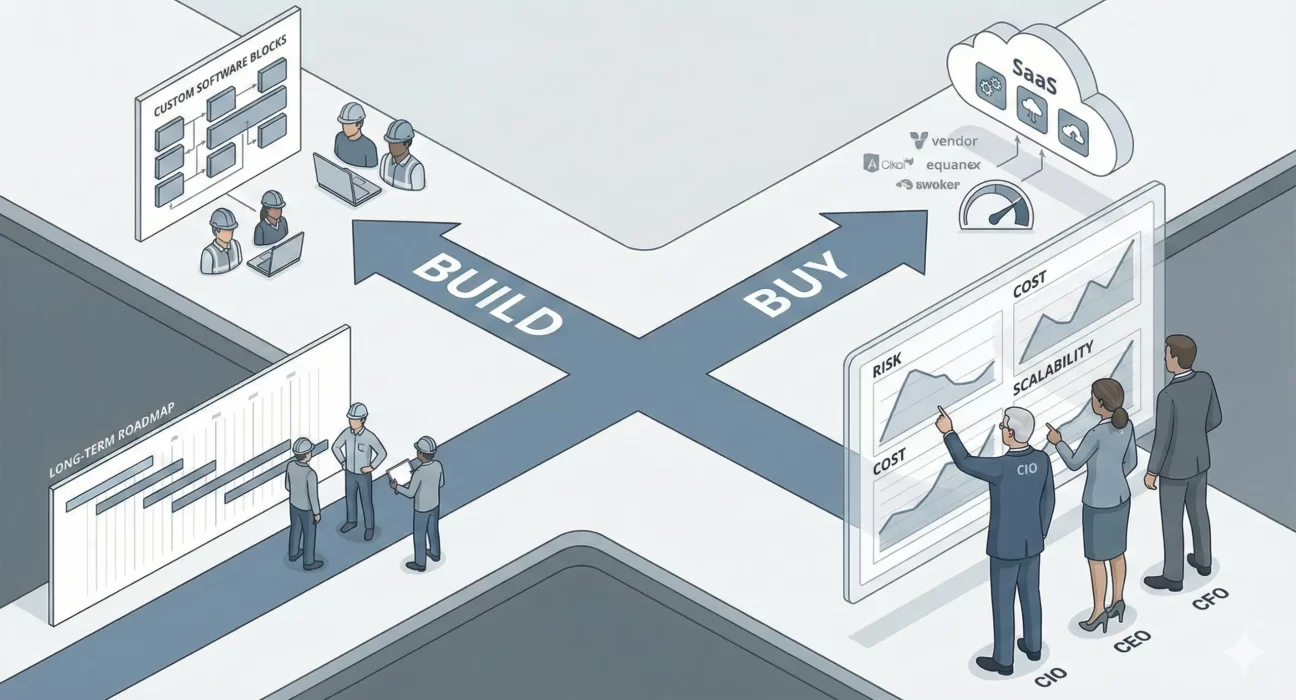
Every CIO has been in that room. The one where the business wants a platform “like Amazon” or “like what our competitor just launched,” and engineering says they can build it in six months. Finance wants a business case. The CEO wants it yesterday. And procurement has already shortlisted three vendors who promise the world.
The build versus buy decision is not really about technology. It’s about risk, time, money, and organisational honesty. Most enterprises get this wrong not because they lack smart people, but because they ask the wrong questions at the wrong time.
This article walks through what actually matters when making these decisions at scale, why so many programs still fail despite better tools and methods, and what it takes to execute well in the real world.
Why This Decision Matters More Than Ever
Ten years ago, buying enterprise software meant long implementation cycles, heavy customisation, and vendor lock-in that lasted a decade. Building meant control, but also meant reinventing the wheel and carrying technical debt forever.
Today, the landscape has changed but the stakes are higher. Cloud platforms, API-first architectures, and modular SaaS tools have made buying faster and more flexible. Open-source ecosystems and low-code platforms have made building more accessible. But enterprises are also more complex. They operate across geographies, navigate stricter compliance requirements, manage legacy systems that cannot simply be switched off, and face competitive pressure that doesn’t wait for three-year transformation roadmaps.
The build vs buy question now shows up everywhere. Customer-facing apps. Internal workflow tools. Data platforms. AI and analytics. Integration layers. Each decision has downstream consequences on cost, speed, flexibility, and risk.
What Actually Goes Wrong
Most enterprise technology decisions don’t fail because of bad technology. They fail because of misaligned expectations, underestimated complexity, and weak execution discipline.
Underestimating the full cost of building
When teams propose building something in-house, the business case usually covers development cost. What it often misses is everything else. Ongoing maintenance. Security patching. Compliance updates. Scaling infrastructure. Hiring or retaining specialised talent. Handling edge cases that only show up in production. Integrating with other systems that weren’t in scope during the original estimate.
A platform that costs ₹2 crore to build might cost ₹5 crore to run and evolve over three years. That math rarely makes it into the initial proposal.
Overestimating what vendors will actually deliver
Buying looks clean on paper. Sign a contract, go through implementation, go live. In reality, most enterprise software purchases involve heavy customisation, data migration that takes longer than planned, integration with legacy systems the vendor has never seen, and change management across departments that didn’t want the new system in the first place.
Vendors are optimistic during sales. They show polished demos and share success stories from other clients. What they don’t always highlight is how much of that success depended on the client’s own execution maturity, data quality, and internal alignment.
The contract gets signed, but six months into implementation, the scope has expanded, timelines have slipped, and the internal team is buried in configuration workshops and user acceptance testing.
Ignoring the integration and ecosystem problem
Enterprises don’t run on single systems. They run on dozens of interconnected platforms, many of which were built or bought over the past decade by different teams with different priorities.
A new CRM needs to talk to ERP. The data lake needs to pull from multiple transactional systems. The mobile app needs real-time access to inventory. The analytics dashboard needs clean, consistent data from everywhere.
Whether you build or buy, integration becomes a hidden project. It’s complex, time-consuming, and fragile. And it’s often where programs get stuck, because no single vendor or team owns the full picture.
Underestimating organisational readiness
Technology doesn’t transform businesses on its own. People do. Processes do.
A new platform might be technically sound, but if the sales team doesn’t trust the data, if the operations team hasn’t been trained, if the finance team is still maintaining parallel Excel trackers because they don’t believe the system is accurate, then the program hasn’t really succeeded.
This isn’t a technology problem. It’s a change management, communication, and leadership problem. Yet it’s treated as an afterthought in most business cases.
The Questions That Actually Matter
The build vs buy decision becomes clearer when framed around execution reality, not just feature comparison or cost estimation.
Is this a core differentiator or a commodity capability?
If the capability directly creates competitive advantage, building might make sense. If it’s table stakes that every company in your industry needs, buying is usually smarter.
A logistics company building proprietary route optimisation algorithms is different from a bank building its own email system. One is strategic, the other is distraction.
But even this isn’t absolute. Sometimes a core capability is better bought and integrated deeply, because the R&D investment required to build and maintain it is better spent elsewhere.
Do we have the execution maturity to own this?
Building software is one thing. Running it in production, securing it, scaling it, evolving it, and supporting it across the organisation is another.
Execution maturity means having strong engineering practices, clear ownership, reliable DevOps, disciplined release management, and the ability to prioritise and say no. It means treating internal platforms with the same rigour as customer-facing products.
Most enterprises overestimate their own maturity here. They assume that because they’ve delivered projects before, they can own complex platforms long-term. In reality, many internal builds end up as technical debt because the team that built it has moved on, documentation is incomplete, and no one wants to touch the code.
What’s the total cost of ownership, honestly?
This includes not just licence fees or development cost, but implementation effort, integration complexity, training, support, upgrades, and the opportunity cost of internal resources tied up in managing the platform.
It also includes exit cost. If you build something custom and it becomes business-critical, replacing it later is expensive and risky. If you buy something and the vendor gets acquired, changes pricing, or discontinues the product, you’re stuck.
Honest TCO analysis requires looking at multiple years, multiple scenarios, and accounting for things that will inevitably go wrong.
How fast do we need this, and how much will it change?
If speed to market is critical and the requirements are reasonably well understood, buying is usually faster. Vendors have already built, tested, and scaled the product. You’re adopting something that works, not starting from scratch.
If the requirements are likely to change significantly, or if the domain is new and you’re still learning what you need, buying can become expensive. Customisation piles up. Change requests slow down. You end up with a Frankenstein version of the product that’s hard to upgrade.
Building gives you flexibility, but only if you build in a modular, maintainable way. Many internal builds become rigid because they’re over-engineered for the first use case and under-designed for future evolution.
Do we have the right partners, not just vendors?
Whether you build or buy, you’ll need partners. System integrators, platform specialists, infrastructure providers, or product engineering teams who can help you execute.
The quality of these partnerships matters more than the contract terms. A good partner understands your business context, challenges you when needed, brings execution discipline, and doesn’t disappear after go-live.
A bad partner delivers what’s in the statement of work, even if it’s the wrong thing, avoids difficult conversations, and measures success by contract closure rather than business outcomes.
What Separates Success from Failure
Across hundreds of enterprise programs, a few patterns emerge consistently in the ones that succeed.
Executive alignment and sustained sponsorship
Programs fail when leadership alignment is shallow. Everyone nods in the first meeting, but when trade-offs appear, priorities diverge. Marketing wants features, operations wants stability, finance wants cost control, and no one has the authority or willingness to make the hard calls.
Successful programs have a clear executive sponsor who owns the outcomes, not just the budget. Someone who can make decisions, unblock teams, manage stakeholders, and keep the organisation focused when everything else is competing for attention.
Realistic scoping and phased delivery
Big bang transformations rarely work. The scope is too large, the dependencies too many, and the risk too high. By the time you go live, the business has moved on and half the requirements are already outdated.
Successful programs are broken into phases that deliver real business value incrementally. Each phase proves something, teaches something, and builds confidence. Teams learn, adjust, and improve as they go.
This requires discipline. It’s tempting to keep adding scope because “we’re already doing this, let’s just include that as well.” But scope creep kills timelines, budgets, and team morale.
Strong program governance, not just project management
Project management tracks tasks and timelines. Program governance ensures that the work being done is the right work, that risks are surfaced and managed, that decisions are made based on facts, and that the organisation is being set up for long-term success.
This means regular business reviews, clear escalation paths, honest reporting, and the ability to course-correct without panic or blame.
Many enterprises have elaborate governance frameworks on paper, but in practice, status meetings become performance theaters where no one admits problems until it’s too late.
Investment in integration, data quality, and change management
These are the three areas most often underfunded in enterprise programs, and they’re usually the reason programs underdelive.
Integration isn’t just technical plumbing. It’s about ensuring that data flows correctly, systems stay in sync, and failures are handled gracefully.
Data quality isn’t just cleansing records. It’s about establishing ownership, defining standards, and building processes that prevent bad data from entering the system in the first place.
Change management isn’t just training sessions. It’s about engaging users early, understanding their concerns, designing workflows that make sense for how they actually work, and supporting them through the transition.
Programs that treat these as afterthoughts pay for it later.
A partner who understands enterprise execution
Many vendors and agencies are good at selling or building. Fewer are good at enterprise delivery. The difference is understanding that enterprise programs are as much about people, process, and governance as they are about technology.
A good partner brings structure without bureaucracy, challenges assumptions without arrogance, and focuses on outcomes rather than activity. They’ve been through this before. They know what breaks, where resistance shows up, and how to navigate organisational complexity.
This is where Ozrit‘s approach matters. Enterprise delivery isn’t just about writing code or configuring platforms. It’s about program discipline, stakeholder management, risk mitigation, and ensuring that what gets built actually gets used and delivers value. The best technology decisions are the ones that come with strong execution support, not just technical capability.
Build, Buy, or Partner: The Real Choice
Increasingly, the answer isn’t purely build or purely buy. It’s a combination.
You might buy a core platform and build integration layers and customisation on top. You might build a differentiated front-end experience and buy the underlying infrastructure and services. You might partner with specialists who bring domain expertise and delivery maturity that you don’t have in-house.
The key is knowing what you’re good at, what you need to own, and where you need help.
When building makes sense
Build when the capability is a true differentiator, when existing solutions don’t fit your unique requirements, and when you have the execution maturity to own it long-term.
Build when you’re in a fast-moving space and need the flexibility to iterate and evolve quickly without waiting for a vendor roadmap.
Build when the strategic value of owning the IP and the platform outweighs the cost and complexity of maintaining it.
When buying makes sense
Buy when the capability is well understood, when strong solutions already exist, and when speed to market matters more than customisation.
Buy when the complexity of building and maintaining the solution is high, and when the vendor has deeper expertise and more resources than you can afford to dedicate internally.
Buy when the opportunity cost of building is too high. Every hour your engineering team spends building something non-core is an hour not spent on what actually differentiates your business.
When partnering makes the difference
Whether you build or buy, the quality of execution depends on having the right partners involved.
For build programs, this might mean working with a product engineering and delivery partner who brings structure, best practices, and the ability to scale the team without compromising quality.
For buy programs, this might mean working with a system integrator who understands both the platform and your business, and can navigate the complexity of implementation, integration, and adoption.
The best partnerships are the ones where the partner has skin in the game. Where success is measured by business outcomes, not just delivered scope. Where the relationship is built on trust, transparency, and shared accountability.
Making the Decision in Practice
Here’s a practical approach to making build vs buy decisions in your organisation.
Start with outcomes, not solutions
Define what success looks like in business terms. Revenue impact. Cost savings. Efficiency gains. Customer experience improvement. Risk reduction.
Then work backwards. What capabilities do you need to deliver those outcomes? What already exists? What needs to change? Where are the gaps?
This keeps the conversation grounded in value, not in features or technology preferences.
Run a proper discovery
Don’t decide based on assumptions or vendor demos. Spend time understanding the problem deeply. Talk to the users. Map the current workflows. Identify the pain points and root causes.
Evaluate what’s available in the market. Not just the leading platforms, but also niche solutions, open-source options, and emerging tools that might not have the marketing budget but solve the problem well.
If you’re considering building, prototype quickly. Test the hardest parts first. Validate that you can actually deliver what you’re proposing, at the quality and scale required.
Model the full picture
Build a realistic business case that includes all costs, all risks, and all dependencies. Include implementation timelines, resource requirements, integration complexity, and change management effort.
Compare scenarios. What does it look like if we build? If we buy option A? If we buy option B and customize? If we delay?
Run sensitivity analysis. What happens if timelines slip? If costs overrun? If adoption is slower than expected?
Involve the right stakeholders early
Don’t make this decision in isolation. Bring in business leaders, technology teams, finance, procurement, compliance, and risk management.
Each group sees different angles. Business cares about speed and functionality. Technology cares about maintainability and integration. Finance cares about ROI and cash flow. Compliance cares about data governance and regulatory risk.
The best decisions balance these perspectives, not just optimize for one.
Commit to execution, not just the decision
Once the decision is made, commit to executing well. That means resourcing it properly, governing it seriously, and staying disciplined when things get hard.
It means being willing to course-correct if early signals suggest the approach isn’t working. And it means holding partners and internal teams accountable for delivery, not just activity.
The Long Game
Enterprise technology strategy isn’t about making one perfect decision. It’s about making good enough decisions quickly, learning from them, and building the organisational muscle to execute well over time.
The companies that win aren’t necessarily the ones with the best technology. They’re the ones that can deliver complex programs reliably, adapt to changing conditions, and build platforms that their people actually use and trust.
This requires leadership that understands execution, teams that are empowered and accountable, and partners who bring maturity and discipline, not just technical skills.
Build vs buy is just the starting question. The real question is: do we have what it takes to execute well, and are we working with people who can help us get there?
That’s the question worth spending time on. And that’s where partnerships like the ones Ozrit enables become valuable. Not because they have all the answers, but because they bring the experience, the structure, and the commitment to see programs through to real business outcomes.
In the end, execution is everything. Technology is just a tool. The rest is leadership, discipline, and the courage to do the hard work that enterprise transformation actually requires.