

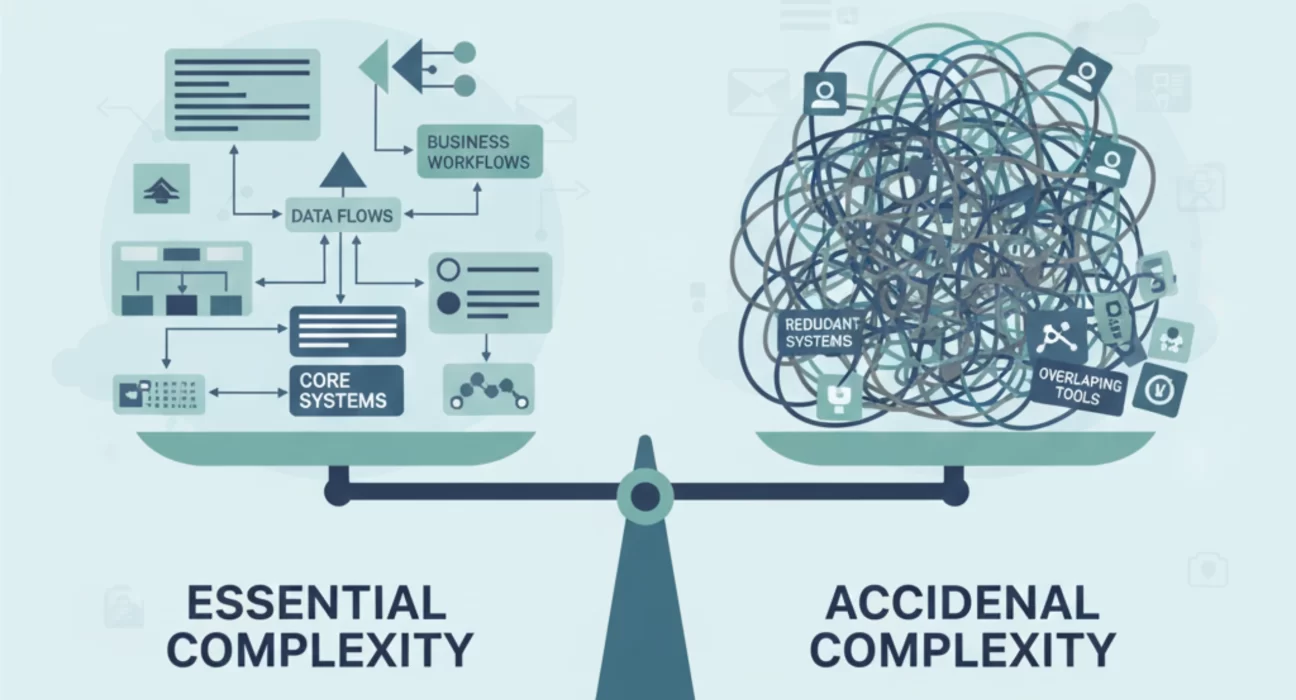
Enterprise architectures grow more complex every year. New systems get added to support new business capabilities. Legacy systems remain because they run critical operations. Integration layers connect everything in increasingly intricate ways. The result is an architecture that few people fully understand, and that becomes progressively harder to change, maintain, and operate reliably.
Most enterprises recognize they have complex problems, but struggle to address them effectively. Simplification initiatives launch with good intentions and then stall because the complexity serves real purposes and can’t just be eliminated. Systems that seem redundant turn out to support specific business requirements. Architectures that appear over-engineered exist because of past failures that leadership doesn’t want repeated.
The path to simpler architectures isn’t about eliminating necessary complexity. It’s about distinguishing between essential complexity that reflects genuine business requirements and accidental complexity that emerged from accumulated decisions, poor coordination, and technical debt. The first needs to be managed carefully. The second needs to be systematically reduced.
How Complexity Accumulates
Enterprise architectures rarely become complex by design. They evolve over the years through thousands of individual decisions that each make sense in context but collectively create systems that are difficult to understand and manage.
A business unit needs a new capability and doesn’t have time to wait for the central platform team, so they build their own solution. A project team chooses a technology that’s different from the standard because it’s better suited to their specific requirements. An acquisition brings a completely different technology stack that needs to be integrated somehow. A vendor relationship ends and systems need to be rebuilt with different tools.
Each decision is rational given the constraints at the time. But the cumulative effect is an architecture with multiple databases, several programming languages, various integration patterns, different deployment models, and inconsistent approaches to security, monitoring, and operations. Nobody designed this complexity. It emerged organically from reasonable local decisions that didn’t consider the global implications.
The challenge is that addressing this complexity requires understanding why each component exists and what business value it provides. You can’t simplify an architecture by just removing things. You need to consolidate capabilities, migrate systems, retire redundant components, and establish clearer patterns. All of this requires time, resources, and careful coordination to avoid disrupting business operations.
The Cost of Architectural Complexity
Complex architectures impose costs that show up throughout the organization. Development teams move slowly because they need to understand multiple systems and technologies. Testing becomes difficult because changes can have unexpected impacts across the architecture. Operations teams struggle because they’re maintaining many different types of systems with different requirements and failure modes.
The financial impact is substantial. You’re paying to maintain and operate more infrastructure than necessary. You’re paying engineers to learn and work with diverse technologies rather than building deep expertise in standard patterns. You’re paying for vendor licenses and support contracts across multiple platforms. You’re paying for delayed projects because architectural complexity makes everything harder.
Beyond direct costs, complexity reduces organizational agility. New capabilities take longer to build because they need to navigate the existing architecture. Changes are risky because it’s unclear what might break. Opportunities get missed because the time required to implement exceeds the window of opportunity. Competitors with simpler architectures can move faster even with fewer resources.
The hidden cost is that complexity tends to increase over time rather than decrease. Each new system adds to the maintenance burden. Each new integration creates another dependency to manage. Each new technology choice fragments expertise further. Without deliberate effort to simplify, the architecture becomes progressively more complex regardless of how much you invest in managing it.
The Modernization Trap
Many enterprises approach complexity by attempting to modernize their entire architecture. They plan multi-year programs to move everything to the cloud, adopt microservices, implement modern development practices, and retire legacy systems. These programs promise simplified architectures as the end result.
Most of these programs either fail to complete or deliver architectures that are complex in different ways. The problem is that they try to solve too many problems at once. They’re simultaneously modernizing technology, changing processes, rearchitecting systems, and migrating data. The scope is enormous, the risks are high, and the business value is often unclear until the program is largely complete.
A better approach is targeted simplification that addresses specific complexity problems with clear business justification. Rather than modernizing everything, focus on the systems or integration points that cause the most operational pain. Rather than adopting new technology everywhere, use it where it provides clear advantages. Rather than eliminating all legacy systems, retire the ones that are most expensive to maintain and pose the highest risk.
This incremental approach delivers value continuously rather than promising it at the end of a multi-year program. It allows learning and course correction along the way. And it’s more likely to succeed because the scope is manageable and the business impact is demonstrable at each step.
Finding the Right Level of Standardization
One path to simplification is standardization. Limit the number of databases, programming languages, and cloud platforms in use. Establish standard patterns for common problems like authentication, logging, and error handling. Require all new systems to follow approved architectural patterns.
Standardization reduces complexity by creating consistency across the architecture. Teams can share knowledge more easily. Operations can manage systems more efficiently. New engineers can become productive faster because they’re working with familiar patterns and technologies.
The challenge is finding the right balance between standardization and flexibility. Too much standardization becomes constraining. Teams can’t use the best tool for their specific problem. Innovation gets stifled because new approaches require exception approvals. And you miss opportunities to improve because the standards reflect past thinking rather than current best practices.
Too little standardization means every team makes different choices, and you end up with a fragmented architecture that created the complexity in the first place. The art is setting standards that provide consistency where it matters most while allowing flexibility where local optimization is valuable.
This typically means standardizing infrastructure, security practices, and operational patterns while being more flexible about application-level technology choices. It means having a clear process for exceptions that balances innovation with the cost of maintaining additional technologies. And it means evolving standards over time based on experience rather than treating them as permanent decisions.
The Database Proliferation Problem
One of the most common sources of architectural complexity is database proliferation. Enterprises often have dozens of databases serving different applications, each with its own schema, access patterns, and operational requirements. Some are relational databases. Others are document stores, key-value stores, graph databases, or specialized analytics platforms.
This proliferation creates genuine operational complexity. Each database needs monitoring, backup, performance tuning, security controls, and upgrade management. Data that spans databases requires complex integration or replication. Making consistent architectural changes requires coordinating across multiple database platforms with different capabilities.
The path to simplification isn’t necessarily consolidating to a single database. Different use cases genuinely benefit from different database technologies. But most enterprises can significantly reduce database complexity by consolidating similar use cases onto common platforms and establishing clearer patterns for when new databases are justified.
This requires understanding not just what databases exist, but why they exist and whether they’re still necessary. Many enterprise databases contain legacy data that’s no longer actively used but can’t be deleted because of retention requirements. Others were created for specific projects and then remained after the projects were completed. Still others duplicate data that exists elsewhere because integration was difficult.
Rationalizing databases requires careful analysis of data dependencies, migration planning, and attention to performance and availability requirements. It’s not fast or simple work. But the long-term operational benefits of having fewer databases to maintain and clearer data ownership patterns make the investment worthwhile.
Dealing with Vendor Lock-in
Much enterprise architectural complexity stems from dependence on vendor platforms and proprietary technologies. You’ve invested heavily in a particular vendor’s ecosystem, built custom integrations, trained teams on their tools, and embedded their products throughout your architecture.
This creates both technical and business complexity. You’re constrained by what the vendor supports. Your roadmap depends on their product evolution. Your costs are subject to their pricing decisions. And extracting yourself would require substantial reinvestment.
Some degree of vendor dependence is inevitable and often appropriate. Major vendors provide capabilities that would be expensive to build yourself. But many enterprises have accumulated more vendor lock-in than necessary because they didn’t design for portability.
Better to architect with clear boundaries between vendor-specific components and your business logic. Use abstraction layers that allow swapping implementations without changing consuming applications. Store data in formats that aren’t proprietary to specific vendors. Build on open standards where they exist rather than vendor-specific APIs.
This doesn’t mean avoiding vendor products. It means using them in ways that preserve your ability to change direction if business requirements or vendor relationships change. The slight additional complexity of abstraction layers is usually worth the reduced risk and increased flexibility.
How Ozrit Approaches Architecture Simplification
At Ozrit, we’ve helped several enterprises reduce architectural complexity while maintaining business continuity. Our approach is based on understanding that simplification is a continuous process, not a one-time project.
We start with a comprehensive architecture assessment that maps the current state, identifies complexity hotspots, and quantifies the operational impact. This goes beyond creating diagrams. We examine actual system usage, interview teams about pain points, analyze operational incidents, and understand the business context that created the current architecture. This assessment typically takes four to six weeks and involves our senior architects working across your organization.
The goal is to understand not just what’s complex, but why it’s complex and what value the current architecture provides. This context is essential because simplification efforts that ignore business requirements or historical context will fail.
Based on this assessment, we develop a simplification roadmap that prioritizes work by operational impact and business value. Rather than attempting to simplify everything at once, we focus on the areas where complexity causes the most pain or limits business capability. We structure the work in phases that deliver measurable improvements in operational efficiency, development velocity, or cost reduction within three to six months.
Each simplification program has a dedicated senior delivery lead from our team who owns the execution. This person coordinates across the various workstreams, manages dependencies, and ensures progress toward the simplification goals. They’re experienced architects who have managed similar programs at other enterprises and understand both the technical and organizational challenges involved.
Our onboarding process accounts for the complexity we’re trying to reduce. We assign engineers from our team of 250+ developers and specialists who have experience working in complex enterprise environments. They spend their first two to three weeks understanding your architecture, the business context, and the specific complexity challenges you’re facing. By week four, they’re contributing to simplification work.
We handle the difficult technical work that simplification requires. Migrating applications between platforms. Consolidating databases while maintaining data integrity. Refactoring integration layers. Retiring legacy systems safely. Our engineers have done this work at scale and know how to manage the risks and dependencies involved.
Because we operate across time zones with 24/7 coverage, we can maintain momentum on simplification programs and respond quickly if issues arise during migrations or system consolidation. Architecture changes often need to happen during maintenance windows or off-peak hours, and having experienced teams available globally makes this work more manageable.
Our simplification programs typically show measurable operational improvements within four to six months, with substantial architecture simplification taking 12 to 18 months, depending on scope. These timelines reflect the reality that you can’t simplify complex architectures quickly without unacceptable risk to business operations.
Building Simpler Architectures Going Forward
The long-term solution to architectural complexity isn’t just simplifying what exists. It’s building capabilities and practices that prevent unnecessary complexity from accumulating in the first place.
This means having clear architectural governance that balances consistency with flexibility. It means making technology choices with long-term maintainability in mind, not just short-term delivery speed. It means investing in documentation and knowledge sharing so architectural decisions are understood beyond the teams that made them.
It also means accepting that some complexity is inevitable and focusing on managing it well rather than eliminating it. Large enterprises serve complex business requirements across varied contexts. The architecture will necessarily have some complexity. The goal is ensuring that complexity is essential rather than accidental, well understood rather than mysterious, and manageable rather than overwhelming.
The enterprises that maintain simpler architectures over time are those that treat architectural simplicity as an ongoing goal requiring continuous effort, not a destination reached through occasional simplification programs. They make architectural clarity a priority in every technology decision. They invest consistently in reducing complexity rather than letting it accumulate until a crisis forces action. And they recognize that architectural simplicity is a competitive advantage worth protecting.