
Most enterprise LMS implementations fail not because of bad technology, but because of bad execution. The software works. The problem is that organizations underestimate the complexity of deploying a learning management system at scale, and vendors underestimate the operational risks of getting it wrong.
When an LMS implementation fails in a large enterprise, the consequences extend far beyond the project team. Compliance training gets delayed. Mandatory certifications lapse. HR processes break. Learning and development programs stall. In regulated industries, this can create audit exposure. In all industries, it creates cost, disruption, and loss of confidence in the technology function.
The mistakes that cause these failures are predictable. They happen in most large-scale LMS projects, and they are avoidable if you know what to look for. This article walks through the five most common implementation mistakes we see in enterprise environments, and more importantly, what you can do to prevent them.
Mistake 1: Treating Implementation as a Technology Project Instead of an Organizational Change Program
The most fundamental mistake is viewing LMS implementation as purely a technology deployment. Organizations approach it the same way they would approach replacing a server or upgrading a database. They focus on technical requirements, system configuration, and go-live dates. They underinvest in change management, stakeholder engagement, and user readiness.
This works for infrastructure projects where end users do not need to change their behavior. It does not work for systems that require thousands of people to learn new processes, access content differently, and interact with learning programs in new ways.
At enterprise scale, an LMS touches multiple stakeholder groups with competing interests. Your L&D team wants flexibility and content creation tools. Your compliance team wants control and audit trails. Your IT security team wants restricted access and data governance. Your business units want autonomy. Your HR team wants integration with performance systems. These groups do not naturally align, and a successful implementation requires orchestrating their needs, not just accommodating them in the software configuration.
The way to avoid this mistake is to treat implementation as an organizational transformation with a technology component, not the other way around. This means investing in stakeholder management from the start. It means building a governance model that clarifies decision rights and accountability. It means creating a communication strategy that keeps leadership informed and users prepared. And it means allocating budget and resources for change management, not as an afterthought, but as a core part of the program.
Organizations that skip this work often get to go-live and discover that users do not understand the new system, business units resist the change, or critical stakeholders were not consulted and now refuse to support the rollout. By then, it is too late to fix these issues without delaying the project or compromising the solution.
Mistake 2: Underestimating Integration Complexity
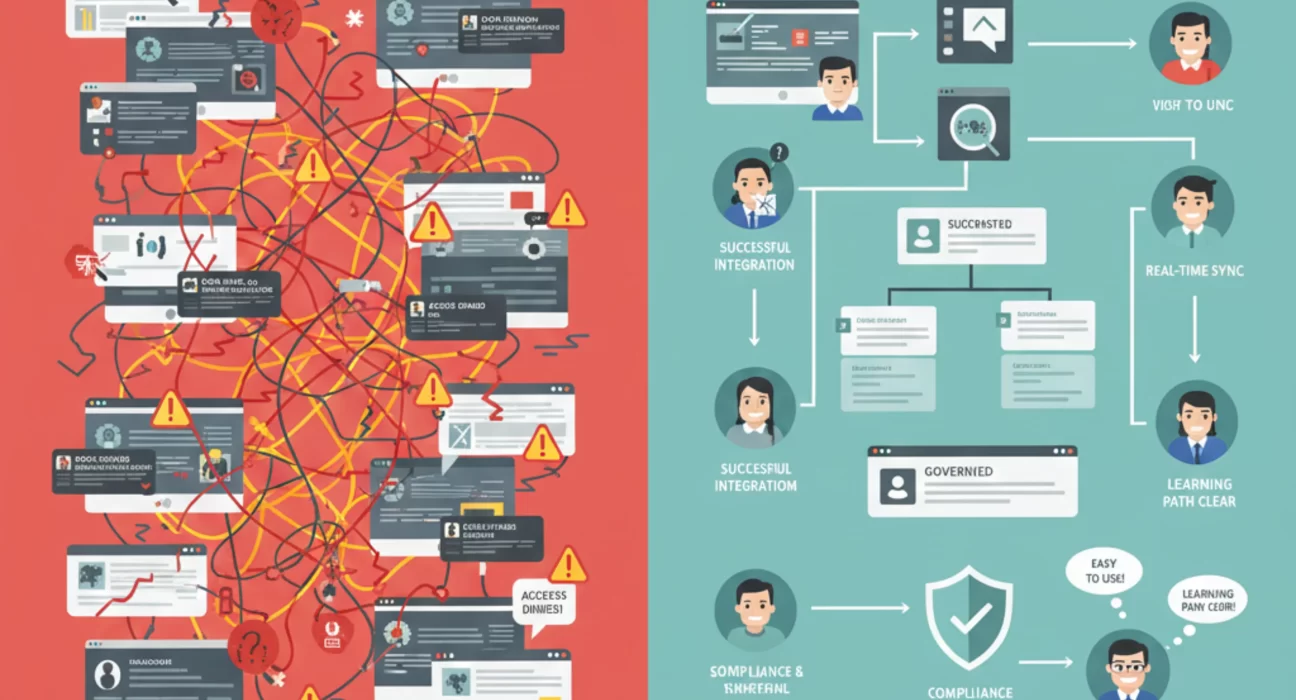
Integration is where most enterprise LMS implementations run into serious trouble. On paper, integrating your LMS with your HR system, identity management platform, and content repositories seems straightforward. In practice, it is the most technically complex and time-consuming part of the project.
The problem is that enterprise systems were not designed to work together. Your HR platform has its own data model. Your LMS has a different one. Your identity management system has a third. Making these systems exchange data reliably requires mapping fields, handling exceptions, managing synchronization timing, and building error handling for when things go wrong. And things will go wrong.
Then there is the organizational complexity. The teams that own these systems often operate independently. Your HR technology team has their own priorities and release schedules. Your IT security team has their own policies and approval processes. Your LMS implementation cannot proceed faster than the slowest dependency, and in large enterprises, dependencies multiply quickly.
Many organizations discover mid-project that a critical integration requires a system upgrade, a vendor API change, or a security review that will take months. The LMS project gets delayed, costs increase, and stakeholders lose confidence.
The way to avoid this mistake is to map out integration requirements and dependencies during the planning phase, not during implementation. This means engaging the teams that own your core systems early. It means understanding their constraints, release cycles, and technical limitations. It means building integration timelines that account for testing, security reviews, and inevitable delays.
It also means choosing implementation partners who have delivered complex integrations before. Generic integration experience is not enough. You need a partner who has connected learning systems to enterprise HR platforms, handled real-time user provisioning at scale, and built data synchronization processes that work reliably across time zones and system maintenance windows.
Mistake 3: Migrating Data Without Proper Planning and Validation
Data migration is one of those tasks that seems simple until you actually attempt it. You have learning records, user profiles, course completions, certifications, and historical data in your old system. You need to move all of that into your new LMS without losing information, corrupting records, or breaking compliance audit trails.
In reality, your old data is messy. There are duplicate user accounts. There are courses that were deleted but still have completion records. There are organizational hierarchies that have changed over time. There are data fields that mean different things in different parts of the organization. Migrating this data directly without cleaning and mapping it first is a recipe for disaster.
The other problem is validation. How do you know the migration worked correctly? Most organizations do spot checks or sample testing. This misses edge cases and low-frequency errors that only become apparent after go-live, when users cannot find their training history or compliance reports show missing certifications.
The way to avoid this mistake is to treat data migration as a structured workstream with dedicated resources and clear acceptance criteria. Start by profiling your existing data to understand what you actually have, not what you think you have. Identify data quality issues early and decide how to handle them. Build transformation rules that map old data structures to new ones. And most importantly, create a validation process that verifies not just that data was moved, but that it is correct and complete in the new system.
For large enterprises with years of learning history and thousands of users, this process can take weeks or even months. Organizations that try to rush data migration inevitably create problems that are expensive and disruptive to fix after go-live.
Mistake 4: Attempting a Big-Bang Rollout Without Phased Validation
Many enterprises plan their LMS implementation as a single cutover event. On a specific date, the old system is turned off and the new system goes live for everyone. This approach seems efficient, but it concentrates all of the risk into a single moment.
If something goes wrong during a big-bang rollout, it goes wrong for your entire organization at once. Users cannot access training. Compliance programs are disrupted. Support teams are overwhelmed. And because the old system has been decommissioned, there is no fallback option. You are forced to fix issues in production while thousands of users are affected.
At enterprise scale, the probability that something will go wrong is high. There will be integration issues that were not caught in testing. There will be user workflows that do not work the way they were designed. There will be performance problems under real-world load. These issues are easier to manage and resolve when they affect a pilot group of a few hundred users, not your entire global workforce.
The way to avoid this mistake is to structure your rollout in phases. Start with a pilot deployment to a limited user group that represents the diversity of your organization. Validate that the system works correctly in your production environment with real users, real data, and real integrations. Collect feedback. Fix issues. Only after the pilot is stable should you proceed to broader rollout.
This approach takes slightly longer, but it dramatically reduces risk. It also builds organizational confidence, because stakeholders can see the system working successfully before it is deployed to their teams. For mission-critical systems like your LMS, this additional validation time is not a delay. It is an investment in stability and delivery certainty.
Mistake 5: Insufficient Post-Implementation Support Planning
Many organizations treat go-live as the end of the implementation project. The vendor delivers the system, users are trained, and the project team moves on to other work. What they fail to plan for is the operational reality of running an enterprise LMS after launch.
Users will have questions. Integrations will break when connected systems are updated. New requirements will emerge as business units start using the system. Performance issues will surface under peak loads. Without proper support structures in place, these issues escalate into operational crises.
The other problem is knowledge transfer. If the implementation was done by external consultants or a vendor team, and that knowledge is not transferred to your internal staff, you become dependent on external resources for even basic system maintenance and troubleshooting. This creates cost, delays, and vulnerability.
The way to avoid this mistake is to plan for post-implementation support before go-live, not after. This means defining support tiers, escalation paths, and response time commitments. It means ensuring your internal team has the training and documentation they need to manage the system. And it means having a support partner who can respond quickly when issues arise, especially in the critical weeks immediately after launch when problems are most likely to surface.
For large enterprises, 24/7 support is not optional. Your LMS supports users across time zones and cannot afford extended downtime. Having a support team that understands your specific implementation and can troubleshoot complex issues quickly is what keeps operations running smoothly.
How Ozrit Helps Enterprises Avoid These Mistakes
Ozrit is a global technology services company that delivers enterprise programs for large organizations. We have implemented learning management systems for enterprises with tens of thousands of users across multiple countries, and we have seen what happens when organizations make the mistakes described in this article.
Our approach is built around reducing execution risk. When we take on an LMS implementation, senior team members stay involved throughout the program. This is not a model where the work gets handed off to junior delivery teams after contracts are signed. Our directors and principal consultants remain accountable for outcomes because they understand that in enterprise work, delivery certainty matters more than speed.
We start every program with a structured onboarding process that surfaces integration dependencies, data quality issues, and organizational constraints before implementation begins. This planning work takes time, but it prevents the mid-project surprises that derail enterprise programs. By the time we begin actual configuration and development, we have a realistic roadmap that accounts for your environment and your stakeholders.
Our delivery methodology is phased and validated. We do not recommend big-bang rollouts for large enterprises. Instead, we structure implementations with pilot phases that allow us to validate the solution in your production environment before scaling. This approach has proven to deliver more stable outcomes and fewer post-launch issues.
After go-live, we provide 24/7 support to ensure that operational issues are resolved quickly. Our support teams have deep knowledge of your specific implementation and can troubleshoot complex technical problems without escalating to vendors or external resources. For mission-critical systems, this level of support is what keeps your learning operations running reliably.
Final Perspective
The difference between successful and failed enterprise LMS implementations is not the technology. It is the execution discipline. Organizations that plan properly, manage complexity deliberately, and work with partners who understand enterprise delivery realities get stable, reliable systems. Organizations that underestimate the work, rush through critical phases, or choose implementation partners based on cost rather than capability end up with disrupted operations and expensive remediation efforts.
The most important decision you make in an LMS implementation is not which software to buy. It is who will deliver it, and whether they have the experience, methodology, and accountability to execute successfully at your scale.