
Your enterprise systems contain the most valuable and sensitive information your organization possesses. Customer data including payment information and purchase history. Employee records with social security numbers and salary details. Intellectual property including product designs and strategic plans. Financial data supporting reporting and compliance. Operational data revealing business performance and competitive position.
A breach exposes this information to unauthorized parties, creating regulatory liability, legal risk, customer trust damage, and competitive disadvantage. The consequences extend well beyond the immediate incident. Regulatory fines under GDPR, CCPA, and sector-specific laws can reach millions. Class action lawsuits from affected individuals create ongoing legal costs. Customer defection affects revenue. Reputation damage impacts recruiting and business development for years.
Despite these stakes, many enterprises approach data security and privacy reactively rather than systematically. Security gets attention after breaches, not before. Privacy controls get implemented to satisfy auditors, not to genuinely protect information. Policies exist on paper while actual practices fall short. The gap between stated security posture and operational reality creates risk that executives often don’t fully understand until an incident occurs.
Effective data security and privacy require deliberate architecture, proper implementation, ongoing governance, and sustained operational discipline. This isn’t primarily a technology problem. It’s an organizational capability that requires clear ownership, adequate resources, proper training, and executive commitment. The technology matters, but only when supported by processes and culture that take security seriously.
Understanding What You’re Protecting
Data security and privacy start with understanding what information you have, where it lives, who accesses it, and what regulations govern it. Most enterprises lack this fundamental visibility.
Data classification identifies sensitivity levels and appropriate protections. Public information requires minimal controls. Internal information needs access restrictions but limited encryption. Confidential information requires encryption, access logging, and regular review. Restricted information demands the strongest controls including multi-factor authentication, detailed monitoring, and strict need-to-know access.
The challenge is that classification often exists in policy without being implemented in systems. Documents are labeled confidential without corresponding technical controls. Databases contain sensitive information without appropriate encryption. Email systems transport restricted data without proper protections. The classification framework doesn’t translate to actual protection.
Data inventory catalogs what information exists across all systems. Customer personally identifiable information in CRM and order management systems. Employee data in HRIS and benefits platforms. Financial data in ERP and reporting tools. Intellectual property in document management and engineering systems. This inventory sounds basic, but many organizations can’t produce comprehensive documentation of where sensitive data lives.
Regulatory mapping identifies which laws govern each category of data. GDPR for European personal data. HIPAA for health information. PCI-DSS for payment card data. SOX for financial controls. Industry-specific regulations for particular sectors. Different regulations impose different requirements for security, privacy, retention, and breach notification. Your controls need to satisfy all applicable regulations, which gets complex for global enterprises.
Data flow documentation shows how information moves between systems, across networks, to third parties, and across borders. Customer data flowing from web applications to CRM to marketing automation to analytics platforms. Employee data synchronizing between HRIS and payroll to benefits administration to learning management. Understanding these flows is essential for implementing appropriate controls and detecting unauthorized data movement.
Access Control and Authentication
Most data breaches involve compromised credentials or excessive access permissions. Proper access control prevents unauthorized access while supporting legitimate business needs.
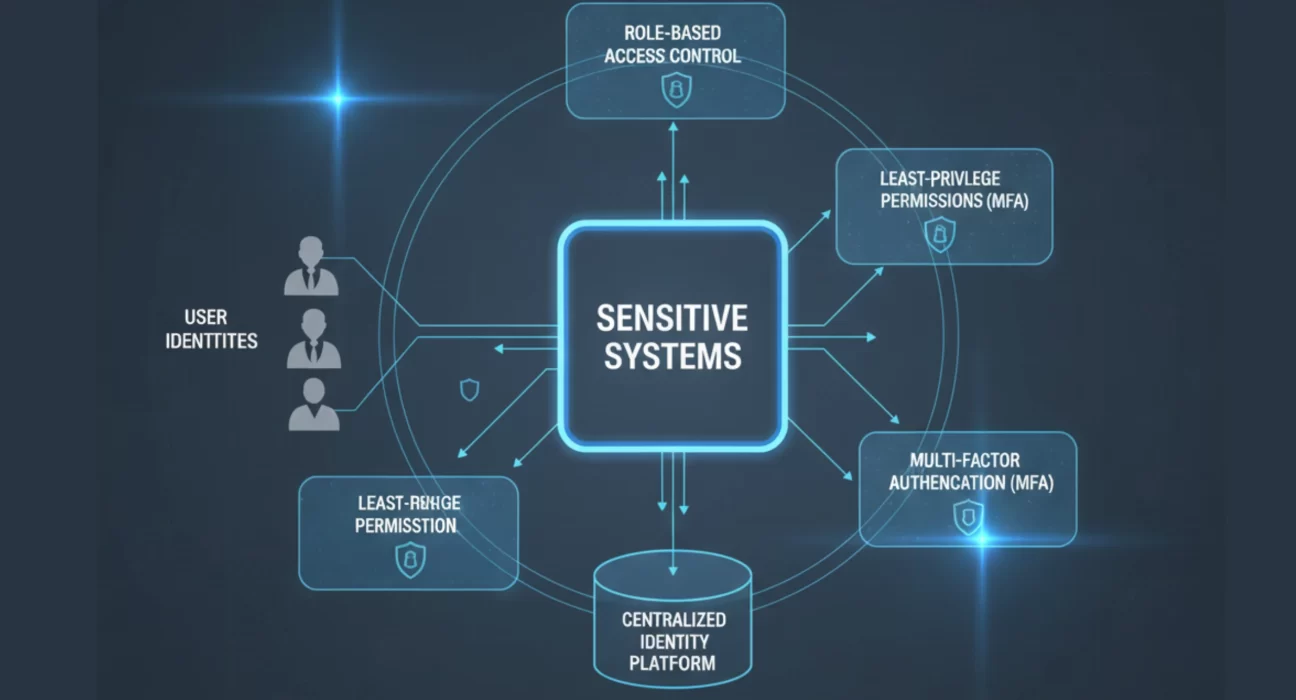
Role-based access control assigns permissions based on job function rather than individual users. Sales roles get access to CRM and customer data. Finance roles get access to accounting and financial systems. HR roles get access to employee information. This approach scales better than individual permission management and reduces risk when people change roles.
The implementation challenge is defining roles with appropriate granularity. Too few roles mean people have access they don’t need. Too many roles become unmanageable. Most enterprises need 20 to 40 well-designed roles rather than hundreds of overly specific roles or five overly broad roles.
Least privilege principle limits access to minimum necessary for job function. People shouldn’t have access to systems, data, or functions they don’t use. This requires honest assessment of what each role actually needs rather than granting broad access because it’s easier than determining specific requirements.
Privilege creep happens when people accumulate access over time as they change roles without losing old permissions. Someone moves from sales to sales management and gains manager access while keeping individual contributor access. They transfer to marketing and gain marketing access while retaining sales access. Regular access reviews identify and remediate this accumulation.
Strong authentication protects access to sensitive systems and data. Username and password alone is insufficient for systems containing confidential or restricted information. Multi-factor authentication should be required, particularly for privileged access, remote access, and systems containing highly sensitive data.
Single sign-on integration with enterprise identity platforms centralizes authentication and enables consistent policy enforcement. Users authenticate once with corporate credentials and access multiple systems without separate logins. This improves security through centralized control and better user experience. It also ensures access revocation when someone leaves the organization affects all connected systems simultaneously.
Session management controls how long authenticated sessions remain active and what happens when they expire. Aggressive timeouts improve security but frustrate users. Reasonable timeouts of 30 to 60 minutes for active sessions balance security and productivity. Sessions should absolutely terminate when users close browsers or lock devices.
Encryption and Data Protection
Access controls prevent unauthorized users from reaching data. Encryption protects data even if access controls fail or storage media is compromised.
Encryption in transit protects data moving across networks. All communication between users and systems should use TLS encryption. All API calls between integrated systems should be encrypted. All data sent to third parties should be encrypted. Unencrypted transmission of sensitive data is unacceptable regardless of whether networks are supposedly private.
Encryption at rest protects data stored in databases, file systems, and backups. If someone gains unauthorized access to storage or if backup media is lost, encryption prevents them from reading the data without decryption keys. Most modern platforms support database encryption, but it needs to be explicitly enabled and properly configured.
Key management determines whether encryption actually provides security. Encryption is only as strong as the protection of decryption keys. Keys should be stored separately from encrypted data, access to keys should be tightly restricted, rotation should happen regularly, and key backup should be secure. Many organizations implement encryption but manage keys poorly, undermining the security benefit.
Data masking displays sensitive information in abbreviated form when full values aren’t required. Show last four digits of social security numbers instead of full numbers. Display credit card information as masked except for last four digits. Show salary ranges instead of exact amounts when precision isn’t needed. This reduces exposure while maintaining necessary functionality.
Tokenization replaces sensitive data with non-sensitive substitutes for certain uses. Payment processing systems receive tokens instead of actual payment card numbers. The tokens are useless if exposed but function properly for authorized transactions. This is particularly valuable when sensitive data needs to flow to systems or partners that don’t require access to actual values.
Monitoring and Incident Response
Security controls only work if you can verify they’re functioning and detect when they’re being circumvented or when incidents occur.
Security monitoring tracks access patterns, authentication attempts, privilege usage, data exports, configuration changes, and other security-relevant events. Automated analysis identifies suspicious patterns like unusual access times, access from unexpected locations, bulk data exports, repeated failed authentication, or privilege escalation.
Real-time alerting notifies security teams of high-risk activities immediately rather than discovering issues during periodic log review. Someone accessing large volumes of customer data. Administrative changes outside maintenance windows. Access from countries where you don’t operate. These patterns warrant immediate investigation.
Log retention preserves security logs for investigation and compliance purposes. Many regulations require retaining logs for specific periods. Your retention should meet the longest applicable requirement while balancing storage costs. Logs are useless for investigation if they’ve been purged.
Incident response plans specific to data security breaches document detection procedures, containment steps, investigation processes, notification requirements, and communication protocols. Generic incident response plans don’t address data breach specifics like determining what data was accessed, what individuals were affected, what regulatory notifications are required, and what remediation is needed.
Breach notification to affected individuals and regulators is required under most privacy laws when personal information is compromised. Requirements vary by jurisdiction but generally mandate prompt notification. The process needs legal review, clear communication about what happened and what affected parties should do, and support resources like credit monitoring if appropriate.
Regular security assessments validate that controls are working as intended. Vulnerability scanning identifies technical weaknesses. Penetration testing attempts to exploit vulnerabilities. Security audits verify that policies are being followed. These assessments should happen continuously, not just before regulatory audits.
Third-Party Risk Management
Your security extends beyond systems you directly control to vendors and partners who access your data or provide services.
Vendor security assessments evaluate third-party security practices before engagement. Review their security certifications, incident history, breach notification procedures, and insurance coverage. Not all vendors have enterprise-grade security, and those that don’t shouldn’t have access to your sensitive data.
Contractual protections define security requirements vendors must meet, breach notification obligations, audit rights, and liability terms. Standard vendor contracts often lack necessary provisions for protecting sensitive information. Security requirements should be explicit in contracts, not assumed.
Integration security controls how data flows to third-party systems. Service accounts should have minimum necessary permissions. API authentication should use secure methods with credential rotation. Data shared with vendors should be limited to what’s actually needed. Many breaches involve vendor compromises, so third-party connections deserve particular scrutiny.
Ongoing vendor monitoring verifies that security remains adequate over time. Annual security questionnaires, periodic audits, monitoring of vendor security incidents affecting other customers. Vendors who were secure when engaged might become risky through acquisition, cost-cutting, or security incidents.
Access termination ensures vendor access ends cleanly when services conclude. Revoke credentials, disable service accounts, verify data deletion where required. Lingering vendor access after contract termination creates unnecessary risk.
Privacy by Design
Privacy should be built into systems from the beginning, not added as afterthought to satisfy compliance requirements.
Data minimization means collecting only information needed for legitimate business purposes. Organizations sometimes capture extensive data without clear justification. Privacy regulations increasingly require identifying lawful basis for collection and limiting collection to what’s necessary.
Purpose limitation restricts data use to purposes for which it was collected. Customer data collected for order fulfillment shouldn’t be used for unrelated marketing without proper consent. Employee data collected for payroll shouldn’t be used for performance analytics without clear policy and communication.
Consent management tracks what permissions were obtained for what purposes, particularly in jurisdictions requiring explicit consent for data processing. The system should document when consent was obtained, for what purposes, and respect consent limitations.
Privacy controls give individuals rights over their data. Access requests let people obtain copies of their information. Correction requests allow updating inaccurate data. Deletion requests require removing information when legally permissible. These capabilities need proper implementation, not just policy statements.
Privacy impact assessments evaluate privacy implications of new systems, processes, or data uses before implementation. What data is involved? What are the privacy risks? What controls mitigate those risks? These assessments prevent privacy problems rather than discovering them after launch.
How Ozrit Approaches Security and Privacy
Ozrit’s work on enterprise security and privacy starts with comprehensive assessment of current controls, data inventory, regulatory requirements, and risk exposure. This assessment identifies gaps between current state and what enterprise-grade security actually requires.
The security architecture design addresses access controls, encryption requirements, monitoring capabilities, incident response procedures, third-party risk management, and privacy controls. The design is specific to your data sensitivity, regulatory obligations, and operational requirements, not generic frameworks that might not fit your environment.
A senior security architect owns the program from assessment through implementation and operational transition. The typical team includes six to ten people: security engineers who implement technical controls, privacy specialists who ensure regulatory compliance, identity management experts who design access controls, and security operations professionals who establish monitoring and response capabilities.
Realistic timelines for comprehensive security and privacy programs run eight to fourteen months depending on current state and scope. Organizations with significant remediation needs, complex regulatory requirements, or many systems requiring security enhancements might need longer. The timeline includes assessment, design, implementation, testing, documentation, and transition to ongoing operations.
Implementation is phased to address highest-risk areas first. Protect most sensitive data, secure most critical systems, address most significant compliance gaps. Subsequent phases expand security controls to additional systems and data.
Ozrit provides ongoing security support because threats evolve continuously and systems change frequently. Regular security assessments, monitoring analysis, incident response support, vendor risk reviews, and privacy compliance updates. This sustained engagement prevents security from degrading as your environment evolves.
The goal is creating sustainable security and privacy practices that genuinely protect information, not just satisfy compliance checkbox requirements. This requires proper architecture, solid implementation, comprehensive monitoring, and continuous improvement as threats and regulations evolve.
The Stakes of Inadequate Security
Security failures create consequences that extend throughout the organization and persist long after the immediate incident is contained.
Direct costs include regulatory fines, legal settlements, forensic investigation, notification expenses, credit monitoring for affected individuals, and remediation work. These costs are quantifiable and get executive attention, but they’re only part of the total impact.
Business disruption from security incidents diverts leadership attention from strategic priorities for months. Responding to the incident, supporting investigations, implementing remediation, restoring stakeholder confidence. The opportunity cost of this disruption often exceeds direct incident costs.
Customer trust damage affects revenue and growth. Customers question whether you can protect their information and whether they want to continue the relationship. Acquisition of new customers becomes more difficult when security reputation is damaged. The revenue impact persists for years.
Employee impact includes identity theft risk for affected individuals, morale damage from employer’s failure to protect their information, and difficulty recruiting when security incidents become public knowledge. People want to work for organizations that take data protection seriously.
Your approach to data security and privacy reflects organizational values and operational maturity. Organizations that invest in comprehensive security demonstrate that they take their stewardship responsibilities seriously. Organizations that treat security as compliance theater or implement minimal controls accept unnecessary risk. The difference shows up when incidents occur and in the daily confidence stakeholders have that their information is being protected properly.