

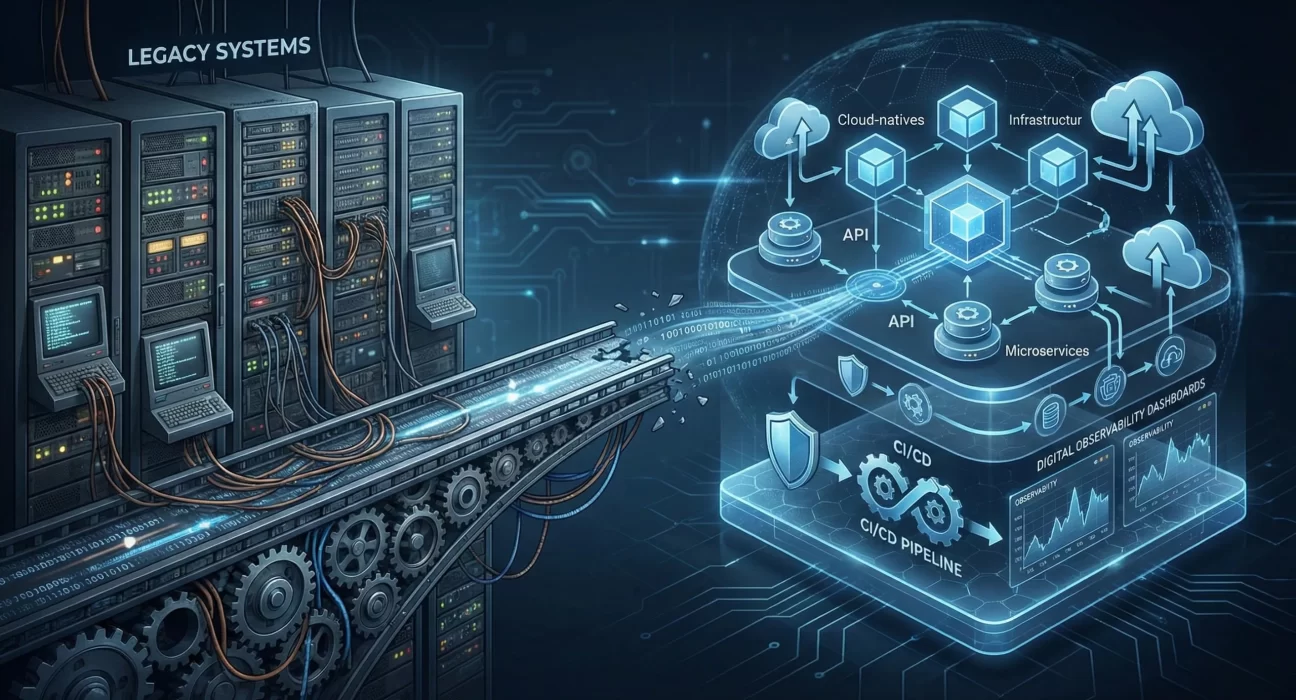
Every CIO knows the feeling. You’re running critical business operations on systems that were built fifteen years ago. They work mostly. But they’re expensive to maintain, difficult to scale, and nearly impossible to integrate with modern platforms. Your business teams want faster releases, better customer experiences, and real-time data. Your finance team wants to reduce infrastructure costs. Your board wants digital transformation.
The answer, everyone says, is cloud-native architecture.
But here’s what nobody mentions in those glossy vendor presentations: refactoring legacy systems isn’t a technology problem. It’s an execution problem. And most large enterprises get it wrong the first time.
Why Legacy Refactoring Fails in Enterprise Settings
Let me be direct about what happens in most organisations.
The program starts with energy. A consultant produces a beautiful roadmap. The technology choices look solid microservices, containers, API gateways, all the right words. Leadership approves the budget. Teams get mobilised.
Then reality hits.
Six months in, the program is behind schedule. Costs have exceeded initial estimates by 30%. The legacy system is more tangled than anyone expected. Business stakeholders are frustrated because promised features haven’t been delivered. IT teams are exhausted, working on parallel systems that both need to stay operational.
This isn’t unusual. It’s the norm.
The problem isn’t cloud technology. The problem is that enterprises treat refactoring as a pure technology upgrade when it’s actually a fundamental change in how systems are built, deployed, and operated. It requires new skills, new processes, new governance models, and often, new organisational structures.
And most critically it requires someone who can actually execute across all these dimensions.
What Legacy Systems Really Mean in Enterprise Context
When we talk about legacy systems in Indian enterprises, we’re usually talking about one of three scenarios.
First, there are the core banking systems, ERP platforms, or billing engines that were built ten or fifteen years ago. They handle millions of transactions. They’re stable. But they’re monolithic, they run on expensive infrastructure, and any change takes months of testing.
Second, there are the systems that were “modernised” five years ago but are already outdated. Someone chose the wrong framework, or the architecture doesn’t scale, or the technology vendor has moved on. These are especially painful because leadership recently spent money on them.
Third, there are the patchwork systems acquisitions that were never properly integrated, departmental solutions that grew into enterprise dependencies, or custom-built platforms that only three people in the organisation understand.
Each scenario needs a different refactoring strategy. But they all share common challenges.
The Real Challenges Nobody Talks About
Parallel Operations and Risk Management
You cannot simply switch off a legacy system and turn on a cloud-native replacement. That’s not how enterprises work.
Your refactoring program needs to run both systems in parallel, sometimes for years. You need data synchronisation strategies. You need rollback plans. You need to manage the risk of running critical operations on a system that’s being actively dismantled.
This parallel operations phase is where costs spiral. You’re paying for old infrastructure, new cloud costs, integration middleware, and double the operational overhead. Finance teams get nervous. Leadership starts questioning the program.
The organisations that succeed plan for this from day one. They build the cost of parallel operations into their business case. They set clear milestones for migrating specific business capabilities. They don’t pretend the transition will be quick or clean.
Skills and Team Capability
Your existing teams know the legacy systems intimately. They can fix issues quickly. They understand the business logic, even if it’s buried in undocumented code.
Cloud-native architecture requires different expertise: container orchestration, distributed systems design, API-first thinking, DevOps practices, observability frameworks. These aren’t skills you can pick up in a two-week training program.
Most enterprises underestimate this gap. They assume developers will adapt. Some will. Many won’t. And the ones who do adapt fastest often get recruited away by product companies offering better compensation.
You need a plan for building or acquiring this capability. That might mean hiring new teams, partnering with specialists who have done this before, or running parallel teams where cloud-native experts work alongside legacy teams to transfer knowledge gradually.
Governance and Decision-Making Speed
Legacy systems usually have heavy governance. Every change goes through multiple approval layers. Testing cycles are long. Release windows are quarterly or monthly.
Cloud-native architecture promises faster releases. But you can’t achieve faster releases without changing how decisions get made. If your deployment needs three weeks of approvals, your microservices architecture won’t deliver the promised agility.
This is where many programs stall. The technology changes, but the organisational processes don’t. You end up with cloud-native infrastructure operating at legacy speed.
Leadership needs to address this directly. You need clearer authority boundaries. You need risk frameworks that allow smaller, frequent changes rather than large, infrequent releases. You need to measure teams on outcomes, not compliance with existing procedures.
Vendor and Partner Management
Most enterprises can’t do this alone. You’ll work with cloud providers, system integrators, niche specialists, and offshore development teams.
Managing this ecosystem is complex. Different vendors have different incentives. Some want to extend timelines to maximise billing. Others will promise unrealistic deliverables to win the contract, then fail to deliver.
You need partners who understand enterprise execution, not just technology. Partners who have worked through messy legacy migrations before. Partners who can navigate your organisation, work with your existing teams, and deliver incrementally rather than in one big-bang release.
This is where working with firms like Ozrit becomes valuable not because they have some magical technology, but because they understand how enterprise programs actually work. They know that delivery maturity matters more than having the latest framework.
What Actually Works: Practical Approach to Legacy Refactoring
Let me share what I’ve seen work in organisations that successfully refactor legacy systems.
Start with Business Capabilities, Not Technology
Don’t begin by choosing your cloud platform or microservices framework. Start by mapping your business capabilities and identifying which ones need to change.
Some legacy functions are perfectly fine as they are. They’re stable, they don’t need frequent updates, they work. Leave them alone for now.
Focus your refactoring effort on capabilities where the legacy system is actively constraining business growth. Maybe it’s customer onboarding that takes too long, or product launches that require six months of IT work, or data analytics that can’t happen because information is locked in old databases.
This business-first approach gives you clearer success criteria and helps prioritise where to invest refactoring effort.
Build for Incremental Migration
The strangler fig pattern works. You build new cloud-native services alongside the legacy system. You gradually route traffic to the new services. You retire old functionality piece by piece.
This approach reduces risk. It allows you to learn and adjust as you go. It means you can show business value incrementally rather than waiting three years for the complete transformation.
But it requires discipline. You need clear interface definitions between old and new systems. You need good monitoring so you know when something breaks. You need teams who can work across both environments.
Invest in Platform Engineering
One mistake I see repeatedly: enterprises refactor one application at a time, and each team builds their own cloud-native infrastructure.
You end up with fifteen different ways of deploying containers, ten different monitoring tools, and no consistent approach to security or compliance. It’s not sustainable.
Successful organisations invest in platform engineering building reusable infrastructure, deployment pipelines, and operational standards that all teams can use. This might feel slow initially, but it pays off enormously as you scale.
Make Data Migration a First-Class Problem
Data migration is usually treated as an afterthought. It’s not. It’s often the hardest part of legacy refactoring.
Your legacy databases have decades of business logic embedded in them stored procedures, triggers, complex relationships that nobody documented. Moving this data to modern databases while maintaining consistency and integrity requires careful planning.
You need clear data governance. You need to decide what data moves, what stays, what gets archived, and what can finally be deleted. You need testing strategies that verify data accuracy across both systems.
And you need to plan for the reality that some data cleanup will be required. Legacy systems often have data quality issues that only become visible when you try to migrate.
Establish Clear Metrics and Accountability
How do you know if your refactoring program is succeeding?
Most enterprises track technology metrics such as how many microservices are deployed, what percentage of workloads are in the cloud, infrastructure cost savings. These matter, but they’re not enough.
You need business outcome metrics. Are releases actually faster? Has customer experience improved? Can business teams launch new products more easily? Are operational incidents decreasing?
And you need clear accountability. Someone senior needs to own this program not just sponsor it, but actively own the delivery. When things go wrong, they need authority to make decisions and unblock problems.
The Role of Leadership in Transformation Success
Let me be clear about something: legacy refactoring programs succeed or fail based on leadership, not technology choices.
I’ve seen programs with perfect architecture fail because leadership didn’t stay engaged. And I’ve seen programs with messy technology succeed because a strong leader kept teams focused, resolved conflicts quickly, and protected the program from organisational politics.
What does good leadership look like here?
Setting Realistic Expectations
Your board wants transformation in eighteen months. Your technology teams say it will take four years. The truth is probably somewhere in between, and it depends on how much scope you’re willing to descend or how much you’re willing to invest in parallel operations.
Good leaders set honest expectations. They don’t promise magic. They explain the trade-offs. They get buy-in for a multi-year journey, not a quick fix.
Protecting the Team from Distraction
Midway through a complex refactoring, someone will propose a new initiative that “should be easy to add since we’re already changing everything.” This happens constantly.
Successful leaders say no. They protect scope. They insist on finishing what was started before adding new requirements.
Building the Right Partnership Model
You need external partners for skills, capacity, and experience. But the wrong partnership model creates dependency and risk.
Look for partners who build capability within your organisation, not partners who want to run everything for you forever. Look for partners who are transparent about challenges and risks, not partners who only deliver good news until the program is in crisis.
The best partnerships I’ve seen including work with organisations like Ozrit are where the partner acts as an extension of the internal team, bringing execution discipline and enterprise program maturity while ensuring knowledge transfer happens continuously.
Long-Term Sustainability: Beyond the Initial Migration
Here’s what most enterprises don’t plan for: what happens after the refactoring is complete?
You’ve moved to cloud-native architecture. You have microservices, containers, automated deployments. Congratulations. Now you need to operate and evolve this new environment.
Cloud-native systems require ongoing investment. Your architecture will need continuous refinement as traffic patterns change and new technologies emerge. Your teams need continuous learning as the ecosystem evolves.
And you need to avoid creating tomorrow’s legacy system today. That means designing for change, documenting decisions, maintaining architectural standards, and resisting the temptation to take shortcuts when under pressure.
Sustainability also means cost management. Cloud costs can spiral quickly if not monitored. You need clear ownership of cloud spending, automated policies to prevent waste, and regular reviews of your infrastructure footprint.
Making the Decision: When and How to Start
So when should your organisation start refactoring legacy systems?
The honest answer: when the cost of not changing exceeds the cost and risk of transformation. That calculation is different for every organisation.
If your legacy systems are preventing business growth, if your competitors are moving faster because they have modern architectures, if your operational costs are unsustainable—these are signals that refactoring makes business sense.
But don’t start until you have the right leadership commitment, the right partners, and the right organisational readiness. A half-hearted refactoring attempt will waste money and demotivate your teams.
Moving Forward with Confidence
Legacy refactoring is hard. It’s expensive. It’s risky. And it’s increasingly necessary for enterprises that want to compete effectively.
The organisations that succeed are the ones that treat this as an execution challenge, not just a technology upgrade. They invest in planning. They build the right teams and partnerships. They stay focused through the difficult middle phase when both systems are running and costs are high.
They work with partners who have been through this before, partners who understand that enterprise transformation is about delivery discipline, governance, risk management, and stakeholder communication as much as it is about cloud platforms and microservices.
If you’re leading a legacy refactoring program, my advice is simple: be honest about the challenges, be disciplined about execution, and be patient about timelines. The technology is ready. The question is whether your organisation is ready to execute.
Because at the end of the day, cloud-native architecture is not a destination. It’s a capability. And building that capability requires the kind of execution maturity that only comes from experience, discipline, and the right partnership approach.