
Healthcare executives face a challenge that doesn’t exist in most other industries. You need digital platforms that scale to serve millions of patients while maintaining compliance standards that can shut down your operations if violated. A retail company can launch a feature and fix problems as they emerge. In healthcare, a compliance failure or data breach can result in regulatory action, legal liability, and damage to patient trust that takes years to repair.
This risk profile shapes every technology decision. Your teams move cautiously because the consequences of mistakes are severe. Projects take longer than planned because compliance reviews identify issues late in development. Innovation slows because introducing new capabilities means navigating regulatory requirements that weren’t written with modern technology in mind. You end up with digital platforms that work but don’t scale efficiently, or platforms that scale but create compliance concerns that keep your legal team awake at night.
Why Healthcare Platforms Can’t Follow Consumer Technology Patterns
Technology executives from other industries sometimes join healthcare organisations and wonder why digital initiatives take so long. The answer becomes clear once they understand the constraints. Patient data has specific protection requirements under HIPAA and state privacy laws. Clinical systems must maintain audit trails that satisfy regulatory scrutiny. Interoperability isn’t optional when payers, providers, and patients all need access to the same information.
These requirements conflict with the standard approach to building digital platforms. Consumer technology companies iterate rapidly, release frequently, and fix issues in production. That model doesn’t work when you’re handling protected health information or supporting clinical decisions. You can’t deploy code on Friday afternoon and see what breaks over the weekend. Every release needs testing that verifies not just functionality but compliance with regulations that carry real penalties for violations.
The integration complexity makes this harder. Healthcare organisations run on systems that were built over decades. Electronic health records that cost tens of millions to implement. Billing systems that connect to hundreds of payers. Clinical applications that physicians depend on for patient care. Your new digital platform needs to work with all of these systems without compromising their compliance posture or introducing data quality issues that affect patient safety.
The Scalability Problem Nobody Talks About
Most healthcare digital platforms work fine at small scale. You can handle ten thousand patient portal users with relatively simple architecture. The problems emerge when you need to support a million users across multiple facilities with different systems and workflows. Response times degrade. Database queries that worked with small data volumes become performance bottlenecks. Features that seemed simple suddenly require complex orchestration across multiple systems.
Scalability in healthcare isn’t just about handling more users. It’s about supporting more complexity while maintaining the same reliability. More facilities means more integration points. More clinicians means more variation in workflows. More patients means more edge cases and exceptions that your platform needs to handle correctly. If your architecture wasn’t designed for this complexity from the beginning, adding scale means rebuilding core components while keeping existing services running.
The compliance dimension adds another layer. At scale, your audit requirements multiply. Every data access needs logging. Every clinical decision needs documentation. Every patient interaction needs to comply with consent preferences that might differ across state lines. Manual compliance checks that worked with limited volume become impossible. Your platform needs built-in compliance controls that operate automatically at whatever scale your organisation reaches.
What Compliance-First Architecture Actually Means
Healthcare organisations often approach compliance as something you add to a platform after it’s built. Security reviews at the end of development. Privacy assessments before go-live. Audit controls implemented when regulators ask questions. This sequence creates problems because fundamental architectural decisions affect compliance in ways that can’t be fixed with late-stage additions.
Compliance-first architecture means making different choices from the beginning. How you structure your data model determines whether you can efficiently support patient privacy preferences. How you design your authentication system determines whether you can maintain audit trails that satisfy regulatory requirements. How you build your integration layer determines whether you can ensure data integrity across system boundaries.
These architectural decisions have long-term implications. A data model that doesn’t cleanly separate protected health information from operational data makes every feature more complex to implement. An audit system that wasn’t designed for high transaction volumes becomes a performance bottleneck. Integration patterns that don’t include proper error handling create compliance gaps when systems fail or data doesn’t sync correctly.
Getting the architecture right requires understanding both healthcare regulations and large-scale system design. Many development teams have one or the other but not both. Compliance specialists who understand HIPAA but don’t write code. Software architects who build scalable systems but don’t work in healthcare. The gap between these perspectives creates platforms that either don’t scale or don’t comply.
The Integration Challenge at Enterprise Scale
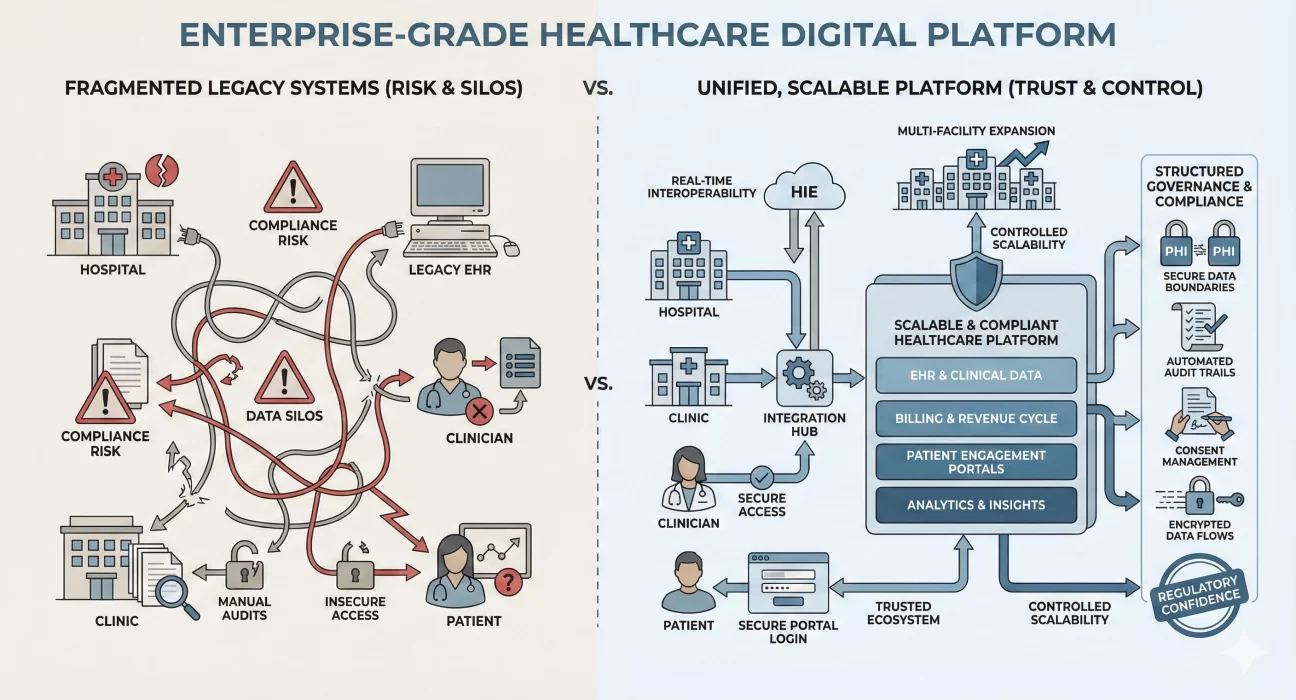
Healthcare enterprises run on a complex web of systems that were never designed to work together. Your EHR came from one vendor. Your billing system from another. Your patient engagement platform from a third. Each system has its own data model, its own API patterns, and its own approach to security and compliance. Building a digital platform that unifies these systems requires more than technical integration. It requires understanding the clinical and operational workflows that span system boundaries.
Standard integration approaches often fail at healthcare scale. Point-to-point connections become unmaintainable when you’re linking dozens of systems. Integration platforms that work for typical enterprise applications struggle with healthcare data volumes and real-time requirements. A patient scheduling change needs to propagate to multiple systems within seconds, not hours. Lab results need to flow to the right clinicians immediately, not after a batch process runs overnight.
The compliance requirements make integration even more complex. You can’t just move data between systems. You need to ensure that every transfer maintains proper authorization, creates appropriate audit trails, and respects patient consent preferences. A single integration that violates these requirements can expose your organisation to significant regulatory risk, even if the technical implementation works perfectly.
How Ozrit Builds Healthcare Platforms That Scale
Ozrit works with healthcare enterprises that need digital platforms capable of supporting their full operational scale while maintaining strict compliance standards. Our approach differs from typical healthcare IT implementations because we design for both scale and compliance from the first architectural decision.
The team structure reflects the dual requirements. A healthcare platform engagement typically includes twenty to twenty-five people with specific healthcare technology experience. This isn’t a team learning about HIPAA while building your platform. These are engineers who have worked on healthcare systems before, understand the regulatory environment, and know which architectural patterns work at scale in compliant environments.
Senior team members with healthcare backgrounds stay involved throughout delivery. They review architecture decisions, validate that compliance controls are properly implemented, and ensure that the platform design can actually scale to your projected volumes. This oversight prevents the common problem where junior developers make decisions that create compliance or scalability issues that only become apparent months later.
Our onboarding process for healthcare engagements runs four to five weeks. We spend significant time understanding your existing systems, your integration requirements, your compliance obligations, and your operational workflows. This includes working with your compliance and security teams to document requirements that might not be written down anywhere but are critical to regulatory adherence. We also review your current audit and monitoring capabilities to ensure our platform generates the logging and reporting you need.
Development timelines for substantial healthcare platforms typically run fifteen to twenty-four months. This includes time for security assessments, compliance validation, integration testing with production systems, and the pilot programs needed to validate that the platform works reliably in real clinical environments. We don’t compress these timelines because shortcuts in healthcare create risks that your organisation can’t accept.
After go-live, healthcare platforms require ongoing support that understands both the technology and the healthcare context. Our 24/7 support model ensures that clinical operations never stop because of technology issues. When your platform experiences problems, you reach engineers who know your system and can resolve issues quickly rather than working through multiple support tiers before finding someone who can actually help.
Technology Choices for Healthcare Scale
Healthcare platforms need to operate reliably for ten to fifteen years. This longevity requirement influences every technology decision. We use proven frameworks and architecture patterns that have demonstrated stability in large-scale healthcare environments. Your platform shouldn’t depend on technologies that might become obsolete or unsupported before your organisation is ready to replace the system.
Data architecture receives particular attention because healthcare generates enormous volumes of information that need to remain accessible for years. We design database structures that can grow efficiently, support the complex queries that clinical and operational teams need, and maintain performance as data volumes increase. This includes strategies for archiving historical data while keeping it available when needed for continuity of care or regulatory requirements.
AI and automation get incorporated where they reduce manual work or improve accuracy. Natural language processing that extracts structured data from clinical notes. Automated monitoring that identifies system issues before they affect users. Intelligent routing that directs patient inquiries to appropriate resources. These capabilities need careful validation because errors in healthcare contexts can affect patient care or create compliance violations.
Security and compliance controls are built into the platform architecture rather than layered on top. Authentication, authorization, audit logging, and data encryption operate automatically for every transaction. This approach ensures that compliance isn’t dependent on developers remembering to include proper controls in every feature they build. The platform enforces compliance by design.
Balancing Innovation With Regulatory Reality
Healthcare executives often feel caught between two pressures. Your board and stakeholders expect digital capabilities that match consumer technology experiences. Your compliance and legal teams remind you of the consequences if those capabilities violate healthcare regulations. Managing this tension requires realistic assessment of what’s actually possible within healthcare’s regulatory framework.
Some digital capabilities that work in other industries simply don’t work in healthcare without significant modification. Real-time data sharing sounds attractive until you consider patient consent requirements and inter-state privacy law variations. AI-driven clinical decision support seems valuable until you examine liability implications and regulatory oversight requirements. These aren’t reasons to avoid innovation. They’re factors that need to be addressed in system design rather than discovered after launch.
The most successful healthcare digital platforms find ways to deliver modern user experiences within compliant architectures. Patients get responsive interfaces and convenient access to their information. Clinicians get efficient workflows and decision support tools. The organisation gets platforms that scale reliably and maintain compliance under regulatory scrutiny. Achieving all three simultaneously requires careful design and disciplined execution, but it’s entirely achievable with the right architectural foundation.
Building Platforms That Support Your Growth
Healthcare organisations invest in digital platforms to support growth, improve operational efficiency, and enhance patient experiences. These goals only materialise if the platforms can actually scale to meet increasing demand while maintaining the compliance standards that protect your license to operate. Getting both scalability and compliance right from the beginning costs more and takes longer than shortcuts that defer difficult decisions. The difference is whether your platform becomes an enabler of growth or a constraint that limits what your organisation can achieve.